Choose timezone
Your profile timezone:

The Italian Network for Computational and Theoretical Neuroscience (INCTN) is a collaborative initiative aimed at facilitating the exchange of information and coordinating activities in the field of computational neuroscience. Its goal is to create a fertile environment that supports the next generation of researchers while promoting the sharing of scientific advances and relevant information. By bringing together the Italian computational neuroscience community, the network seeks to enable more effective actions to increase its visibility and strengthen scientific exchanges with related communities.
This event was the third meeting organized by INCTN. It was hosted at SISSA (International School for Advanced Studies) in Trieste over three days, 22-24 September 2026. The program was structured around three main topics: Theoretical Neuroscience, Computational Neuroscience, and Systems Neuroscience. Invited speakers include researchers based both in Italy and abroad who maintain strong connections with the Italian scientific community.
Keynote Speakers
Sandro Romani (Janelia)
Fanny Cazettes (CNRS, Aix Marseille)
Máté Lengyel (Cambridge)
Invited Speakers
Mario Di Poppa (UCLA)
Peter Neri (IIT)
Giulia Cisotto (U Trieste)
Lorenzo Posani (CNRS, ICM)
Francesca Mignacco (Princeton)
Samuel Muscinelli (U Chicago)
Gianluigi Mongillo (CNRS)
Federico Rossi (IIT)
Giulio Bondanelli (Claude Bernard Lyon)
Umberto Olcese (U Amsterdam)
Carlotta Martelli (U Mainz)
This meeting was funded by the SISSA Neuroscience Area (TEX Conference Funding) and the European Research Council (ERC).
Experience unfolds continuously, so the activity patterns available to memory circuits are rarely independent. Classical Hebbian learning strengthens connections between neurons that are active together. In a recurrent network, this can bind correlated patterns into one expanding assembly. How can successive experiences remain distinct rather than collapse into a single memory?
Intracellular recordings in hippocampal area CA1 revealed an unexpected clue. A single dendritic plateau could create a place field in a silent neuron or relocate an existing field. The resulting behavioral timescale synaptic plasticity (BTSP) links presynaptic activity to a postsynaptic plateau across seconds rather than milliseconds and potentiates or depresses synapses depending on their existing strength. In CA3, targeted perturbations and modeling converged on a time-symmetric form of BTSP operating at recurrent synapses. Together, they showed how this rule can build memory-supporting attractor dynamics whose expression and updating remain controlled by external input.
Theoretical analysis showed that BTSP can reverse the effect of temporal correlation on memory storage. Under Hebbian learning, increasing correlation merges patterns and reduces memory capacity. With BTSP, potentiation near the plateau strengthens the selected representation, while depression in two temporal flanks weakens cross-pattern connections in both directions. This keeps successive representations distinct and allows attractor capacity to increase as correlation grows. These results raise broader questions. What does BTSP store when experience is hierarchically structured, and how do existing memories shape what is learned next? A plasticity rule measured in vivo can turn the continuity of experience from a source of interference into useful structure for continual learning.
The dynamics of large neuronal networks are notoriously difficult to study analytically, because of their high dimensionality. Characterizing network equilibria, instead, is far more tractable. What information about the network's dynamics, then, can we infer from the knowledge of its equilibria? Here, we address this question by focusing on random networks. These networks exhibit a paradigmatic transition from a unique, stable equilibrium to extensive chaos as the synaptic gain increases. Employing the Kac-Rice formalism, we compute the typical number of hyperbolic equilibria, and determine their stability and their geometric organization in phase space. In the chaotic regime, an exponentially large number of equilibria is present; they are all saddles with an extensive, yet fractionally small, number of unstable directions. Surprisingly, despite the network's connectivity being completely random, the equilibria are strongly correlated and, as a result, occupy a small region in phase space. The attractor is inside this region. Because of this geometric organization, the quantitative features of the equilibria provide natural bounds on the network's dynamics. In particular, the fraction of positive Lyapunov exponents is bounded from above by the fraction of unstable directions of typical equilibria. This explains why the dynamics in these models can be described by a fractionally small number of effective degrees of freedom. Our results demonstrate how the spatial and spectral properties of the equilibria place strong, quantitative constraints on the dynamics.
Neural codes must support different kinds of computation. In particular, they need to preserve latent relations among experimental and task conditions through abstraction, so that a rule learned in one context can transfer to another, and compositionality, so that knowledge of observed feature combinations can guide responses to previously unseen combinations. At the same time, they must be flexible in order to simultaneously implement many tasks through simple downstream readouts. We develop a high-dimensional theory based on a model that preserves key aspects of latent task geometry, neural encoding and trial variability, while remaining analytically solvable in the limit of infinitely many neurons. We derive exact asymptotic formulae for observables that quantify these computational capabilities, including storage capacity and cross-condition generalization performance, and show how they are controlled by geometric properties that can be measured directly from neural population recordings.
Recurrent Neural Networks provide versatile models for studying dynamics in neural circuits (Barak, 2017). While numerical simulations can reproduce complex neural phenomena, analytical approaches are needed to uncover their underlying mechanisms. Dynamical Mean Field Theory (DMFT) has provided such a framework for large random networks, allowing the derivation of statistical descriptions of neural activity under simplifying assumptions (Sompolinsky et al., 1988). These assumptions typically include homogeneous connectivity statistics, which limit the ability to capture biologically relevant structural variability.
Here, we extend DMFT to heterogeneous network architectures by introducing heterogeneous Dynamical Mean Field Theory (hDMFT) (Park et al., 2024). This framework incorporates arbitrary degree distributions while preserving a tractable Gaussian effective description. We show that degree heterogeneity induces neuron-dependent dynamical properties and shapes the phase diagram of recurrent networks by enhancing dynamical instability compared to homogeneous architectures.
When partial symmetry is introduced to account for reciprocal connectivity (Song et al., 2005) or learning-induced structure (Clark and Abbott, 2024), hDMFT predicts the emergence of neuron-dependent effective self-interactions whose strength scales with neuronal degree. This mechanism produces a broad distribution of intrinsic timescales, with highly connected neurons exhibiting slower dynamics. The theoretical prediction that neuronal timescales correlate with in-degree is supported by analysis of the MICrONS dataset (Functional connectomics spanning multiple areas of mouse visual cortex, 2025), which combines structural connectivity with neural recordings.
The hDMFT framework provides an analytical link between structural heterogeneity and emergent network dynamics, including phase transitions, collective activity, and response properties. These results establish how connectivity statistics can shape the functional diversity and computational capabilities of large-scale recurrent neural systems.
The neural activity patterns underlying decision formation and execution have been extensively characterized, yet the connectivity motifs that generate these computations remain difficult to measure directly. Although theoretical models propose diverse circuit architectures for decision-making, inferences based on measurements of neural activity alone cannot readily distinguish among them or even determine whether decision signals arise from local microcircuit connections or are inherited from distributed inputs. Here we used influence mapping — combining single-cell photostimulation with calcium imaging — to measure effective connectivity motifs in posterior parietal cortex (PPC) during a navigation decision task. We found that PPC connectivity is dominated by two inhibitory motifs that dynamically switch PPC between distinct computational regimes within single trials. During sensory evidence accumulation, photostimulation preferentially excited neurons with matching choice selectivity while suppressing neurons with opposite selectivity, consistent with an opponent inhibition motif that supports decision formation. During the subsequent delay period, neurons instead preferentially suppressed neurons with matching selectivity, forming an asymmetric like-suppresses-like motif that propagated choice information sequentially across neuronal populations. Computational modeling showed that competition between these inhibitory motifs enables PPC circuits to switch from decision formation to propagation of decision-related activity. Together, these results localize core decision computations to PPC microcircuits and reveal that, unlike in traditional models, inhibitory connectivity motifs are critical for decision-making, including as drivers of transitions between decision formation and execution.
Adaptation is a fundamental component of motor learning, enabling organisms to adjust to environmental changes while maintaining stable motor memories. A long-standing view is that this balance emerges from the interaction of learning processes operating at different timescales, yet the mechanisms that coordinate rapid adaptation with slower consolidation remain unclear. Because motor learning is distributed across multiple brain areas, this raises the question of how these systems interact to support both flexibility and stability.
Here, we propose a distributed learning framework in which adaptation and memory arise from the interaction of fast and slow systems that learn simultaneously but at different rates. We implement this in a multi-area architecture of two networks with distinct roles: a slow recurrent controller, corresponding to motor cortex, that stores stable, slowly evolving representations, and a fast feedforward adapter, corresponding to the cerebellum, that rapidly learns to predict the controller's error in response to perturbations.
We show that defining the two modules in this complementary way — with the adapter learning to predict the controller's error — allows a single signal to serve two roles: it supports efficient online correction of the system's output while simultaneously guiding the controller's local plasticity, enabling the gradual and efficient adaptation of its learned representations into long-term memory. This division of labor provides a mechanistic account of how fast error-driven learning can instruct slower, more stable representations through biologically plausible local rules. The model offers a unified perspective on how rapid adaptation and memory formation coexist within distributed circuits, and suggests how cerebellar–cortical interactions may support motor learning. More broadly, it highlights how predictive signals generated by fast processes can shape long-term representations in slower systems.
Reservoir computing (RC) provides an efficient framework for data-driven modeling of nonlinear dynamics, yielding an autonomous dynamical system that faithfully reproduces the driving dynamics. However, where contextual labels are not present, standard RC learns an independent readout for each time series, with no shared structure across tasks, no generalization to unseen parameters, and no sample efficiency across families of related systems. To overcome these limitations, we developed a modal decomposition describing each system's readout as a linear combination of a shared basis in the readout space, with task-specific mixing coefficients acting as latent variables. Both basis and coefficients are inferred jointly from raw data via expectation maximization with closed-form steps. The reservoir serves as a canonicalizing map: heterogeneous input sequences are projected into a common feature space where cross-task variability reduces to a low-dimensional structure. After orthonormalization, each basis element captures an independent mode of variation, and the latent coordinates spontaneously organize according to the governing physical parameters, enabling interpolation and extrapolation to unseen dynamical regimes in closed-loop generation. We first validate the methodology on families of dynamical systems and on a public dataset of locomotion patterns. We then apply this framework to build patient-specific digital twins of sensorimotor behavior in a clinical cohort of healthy, mildly cognitively impaired, and Alzheimer's disease participants performing reaching and catching movements in virtual reality. Each trial is compressed into a handful of coefficients that faithfully reproduce the recorded kinematics in closed loop. At the trial level, the coefficients encode kinematic features of the movement. Crucially, the latent-space organization degrades with cognitive impairment: the geometry of the distribution of the individual coefficients progressively deteriorates, reflecting reduced motor planning precision. Learned entirely without clinical supervision, these signatures separate diagnostic groups and track cognitive scores, yielding an interpretable dynamical biomarker of neurodegeneration derived from motor behavior.
Organisms continually tune their perceptual systems to the features they encounter in their environment. We have studied how this experience reorganizes the synaptic connectivity of neurons in the olfactory (piriform) cortex of the mouse. We developed an approach to measure synaptic connectivity in vivo, training a deep convolutional network to reliably identify monosynaptic connections from the spike-time cross-correlograms of 4.4 million single-unit pairs. This revealed that excitatory piriform neurons that respond similarly to each other are more likely to be connected. We asked whether this like-to-like connectivity was modified by experience but found no effect. Instead, we found a pronounced effect of experience on the connectivity of inhibitory interneurons. Following repeated encounters with a set of odorants, inhibitory neurons that responded differentially to these stimuli both received and formed a high degree of synaptic connections with the cortical network. This experience-dependent organization of inhibitory neuron connectivity was independent of the tuning of either their pre- or their postsynaptic partners, suggesting a cell-intrinsic, non-Hebbian mechanism. We developed a recurrent network model of the piriform network that recapitulates this experience-dependent connectivity organization, and found that it increases the dimensionality of the entire network’s responses to familiar stimuli, thereby enhancing their discriminability. We confirmed that this network-level property is present in physiological measurements, which showed increased dimensionality and separability of the evoked responses to familiar versus novel odorants. Thus a cell-intrinsic plasticity mechanism acting on inhibitory interneurons may implement a key component of perceptual learning: enhancing an organism’s discrimination of the features particular to its environment.
Brain coordination is typically studied one pair at a time, yet pairwise functional connectivity cannot capture coordination among three or more regions beyond their pairwise couplings. When higher-order structure is detected, two questions remain: whether it is irreducible to its lower-order parts, and whether it is better described as a simplicial complex, a group supported by all its constituent pairwise interactions, or as a hypergraph, which carries collective structure without such support. We treat these as two poles of a single continuum fixed by the data. Each subject's resting-state fMRI (100 Human Connectome Project participants; 116 regions) is encoded as a binary bipartite network of regions and time points, a region active when its BOLD signal exceeds one standard deviation from its mean in magnitude, against which we build a hierarchy of maximum-entropy null models. A first-order model (the Bipartite Configuration Model) validates pairwise co-activations; a second-order model with nonlinear constraints (the Bipartite Partial Local Overlap Model, introduced here) validates triadic co-activations against a null preserving each region's aggregate pairwise co-activation. Significance uses one-sided Poisson–binomial tests under Benjamini–Hochberg FDR control (α=0.05). Each validated triplet is placed on a simplicial–hypergraph spectrum: a 2-simplex when its three pairs are also significant, a hyperedge when none are, mixed otherwise. Only 6.7% of candidate triplets survive; of these, 27% are simplicial, 7% hyperedges, 66% mixed. Position varies along the unimodal-to-transmodal gradient: simplices predominate in sensorimotor cortex and give way to hyperedges in limbic and subcortical systems. Along the same ordering, spatial, functional and information-theoretic signatures covary: toward the hyperedge pole triplets become spatially dispersed and functionally heterogeneous, while their O-information falls monotonically to near-zero. Simplices thus index compact, redundant coordination within functional modules, hyperedges long-range integration across them. Higher-order coordination is graded rather than dichotomous. We release the pipeline as the open-source package Trident.
Low-intensity focused ultrasound offers a non-invasive route to modulate neural activity with high spatial selectivity, but its cellular mechanisms remain unresolved and parameter-dependent. The SEVERUS project addresses this gap by testing alternative, non-exclusive hypotheses for focused ultrasound stimulation in neuronal networks.
We hypothesize that focused ultrasound can influence excitability through (i) local thermal transients that modify membrane conductance and channel kinetics without tissue damage; (ii) acoustic cavitation or intramembrane nanobubble dynamics that alter membrane capacitance and generate displacement currents; (iii) acoustic radiation forces and membrane deformation that activate mechanosensitive ion channels, including Piezo/TRP-like pathways; and (iv) acoustic streaming/shear-mediated changes in the neuron–glia microenvironment. These processes may converge on voltage-gated conductances, synaptic transmission, and network synchrony, producing either excitation or inhibition according to frequency, intensity, duty cycle, pulse duration, cell type, maturation state, and circuit architecture.
SEVERUS integrates multi-scale in silico modelling with controlled in vitro validation to move beyond trial-and-error ultrasound parameter tuning. Biophysically grounded models will link acoustic fields to membrane mechanics, ion-channel dynamics, and spiking/synaptic activity, enabling parameter sweeps that are difficult to perform experimentally. Predictions will be tested in brain-on-chip platforms hosting human cultures of neurons and astrocytes, with concurrent ultrasound stimulation, electrophysiology, and calcium imaging. The iterative comparison between simulations and experiments will identify which mechanisms dominate under defined stimulation regimes and whether responses differ between species and cellular phenotypes.
By resolving how low-intensity ultrasound interacts with neural tissue, SEVERUS will provide mechanistic rules and predictive tools for safer, reproducible, and personalized focused-ultrasound neuromodulation in neurological disorders.
Understanding how structural connectivity, together with intrinsic dynamics, shapes neural activity is one of the central problems in theoretical neuroscience. Large-scale brain rate models provide a bridge between anatomical connectomes and neural dynamics. However, it remains unclear how anatomical connectivity, excitatory--inhibitory interactions, and region-specific intrinsic time constants jointly form effective propagation patterns that determine how activity initiated in one brain region propagates to another. This unresolved problem limits our ability to extract interpretable dynamical principles from increasingly detailed brain-region-level connectome data. Here, we propose a dual-perspective mathematical framework for linking connectome structure to transient dynamics in large-scale brain networks. The first is a spectral perspective, in which transient responses are characterized by the eigenvalue distribution, eigenvector structure, and inverse eigenvector matrix of the effective connectivity. This perspective provides a compact whole-network description of signal propagation, and we testify under soecific spectral structures such as weak localization and weak orthogonality, referred to as weak GBA, observed in the primate cortical model. The second is a motif-based perspective, in which Newman expansions decompose node-to-node responses into contributions from branching walks, together with the intrinsic dynamics of the nodes involved. This perspective is useful when the global spectral structure does not exhibit detailed or easily interpretable features. We first analyze classical motifs composed of feedforward and feedback walks, and then assemble these local motifs to understand propagation patterns in cases where global spectral organization is less informative, including the primate model within the strong GBA regime and the marmoset cortical model. Together, this work analyzes neural activity propagation through two complementary perspectives: global spectral organization and local structural mechanisms. It provides a quantitative theoretical framework for understanding how brain structure shapes transient neural activity propagation.
The ability to form associations between related items is fundamental for episodic memory. In the hippocampus, single-neuron recordings in humans suggest that memories are represented by overlapping neuronal assemblies, in which shared neurons encode associations between distinct but related items. Furthermore, theoretical work using static attractor networks has demonstrated that such overlaps can support associative recall within a critical range of overlap sizes, beyond which memories either remain independent or inevitably trigger the activation of each other, becoming functionally indistinguishable. However, how such partially overlapping assemblies emerge and evolve in a dynamic network remains largely unexplored. Here, we present a computational framework that explains how partial overlaps can emerge as a function of repeated co-stimulation of initially orthogonal neuronal assemblies. The network combines ongoing Hebbian plasticity and spontaneous activity with heterogeneous intrinsic excitability and compensatory mechanisms that stabilise the learning dynamics. We found that repeated co-activation of orthogonal assemblies led to the gradual recruitment of shared neurons, with the overlap size scaling systematically with the relative frequency of paired versus individual stimulations. Moreover, by varying the distribution of intrinsic excitability across the network, we could modulate both the overlap size and the critical frequency of paired stimulations at which the overlap transitioned from partial to full overlap (i.e. merging of the assemblies). These results provide a mechanistic explanation for the formation and evolution of overlapping memory assemblies encoding associated items, bridging a gap between findings with single-neuron recordings in humans and theoretical predictions from attractor network theory.
A major challenge in systems neuroscience is understanding how external perturbations interact with ongoing brain activity. Transcranial magnetic stimulation (TMS), increasingly used in both basic and clinical neuroscience and often combined with electroencephalography (EEG), provides a unique opportunity to probe this interaction. However, how intrinsic dynamics constrain the propagation of TMS-evoked activity remains poorly understood. In particular, effective connectivity (EC)—capturing directed, state-dependent interactions between brain regions—is thought to critically shape perturbational spread, yet remains difficult to estimate at the whole-brain EEG level. Here we introduce an analytically tractable, generative whole-brain model that links spontaneous EEG activity to cortical responses under perturbation. By deriving a closed-form expression for the model′s cross-spectral density, we directly fit empirical resting-state EEG spectra and infer biophysically interpretable local dynamical parameters without time-domain simulations. We then estimate stimulation-site-specific EC using only a small fraction of the TMS-EEG trials. The resulting model accurately predicts the spatiotemporal structure of TMS-evoked potentials (TEPs) in unseen trials. Moreover, even without subject-specific refitting, group-level EC templates capture canonical site-specific propagation motifs underlying single-subject early TMS responses. Together, our results establish an analytical framework for individualized whole-brain modeling of TMS-EEG with potential applicability to model-based neuromodulation.
Cortical sensory maps vary across species. In visual cortex, some animals organise neuronal preferences into smooth topological maps, whereas others show a salt-and-pepper-like arrangement. Both architectures can support sensory coding, but it remains unclear why evolution favours one organisation over the other. We propose that these architectures represent alternative solutions to a trade-off between local and global wiring costs.
Our model separates lateral cortical connectivity into a local pool, which supports organised domains and activity pooling, and a global pool, which supports longer-range interactions. Large local domains require more local connections, but pooling across these domains makes cortical activity more robust to connection loss and permits sparser global connectivity. By contrast, salt-and-pepper-like organisation reduces local wiring requirements but provides less pooling, requiring denser global connectivity to preserve function. The preferred architecture is the one that achieves matched coding performance and stability with the lowest total number of realised connections.
Using self-organising computational models, we measured combinations of local and global sparsity that preserved 95% of unperturbed activity stability. These simulations revealed a trade-off: increasing local pooling allowed greater sparsity in the global connection pool. We incorporated these relationships into a wiring-cost function and combined them with anatomical estimates of local and global connection pools across species.
The model predicts a crossover between two economical regimes. Salt-and-pepper-like organisation is cheaper when global connection demands are relatively small, whereas topological maps become cheaper when savings from sparse global connectivity outweigh the added cost of building large local domains. Applied to species-level data, the lower-cost regime was consistent with the observed cortical organisation across the animals.
These results suggest that topological and salt-and-pepper cortical maps can be understood within a common wiring-economy framework. More generally, cortical map architecture may reflect the minimum synaptic cost required to achieve robust and functionally adequate neural coding.
Low-rank recurrent networks are a mathematically tractable framework for relating connectivity to activity in biological and artificial neural networks. Such networks produce low-dimensional activity, consistent with brain recordings during cognitive tasks, and despite their simplicity can implement a variety of complex computations. How learning shapes their connectivity to do so, however, remains not fully understood.
Here, we build a theory of trained networks that explains how this structure emerges from the imposed task. To this end, we develop a dynamical mean-field theory (DMFT) of task adaptation in low-rank recurrent networks, giving a Bayesian description of how an ensemble of untrained networks (the prior) becomes an ensemble of trained networks (the posterior) [Fischer et al., 2024; Lauditi et al., 2025; Bauer et al., 2026; Clark et al., 2026]. Previous work has shown that the dynamics of low-rank networks can be described by a set of magnetization-like order parameters [Mastrogiuseppe et al., 2018], which measure how strongly the neurons' activities align with the connectivity vectors. In our theory, we recover this description and the corresponding order parameters as the dominant saddle point of an action. Task adaptation then amounts to adding a loss term to the action, shifting this saddle point from 'task-agnostic' to 'task-adapted'. This displacement is characterized by two fields: one field that drives the solution away from the task-agnostic one, and a second field that measures the discrepancy between the network output and the target. Together, they capture how the weights and the neuronal activity are reshaped by task adaptation.
We validate the theory on a variety of tasks, each requiring different structure in the connectivity. Using the two fields, we predict how the distribution of low-rank weights changes with task adaptation, morphing from initial unstructured Gaussians into non-Gaussian distributions whose shape depends on the task.
Closed-loop control of cortical population activity is increasingly investigated for circuit-specific neuromodulation and neural prostheses, and as a causal tool to probe learning and plasticity. Classical control theory, however, requires prior knowledge of circuit connectivity and dynamics (Gu,2015). Baggio, 2019 showed that finite-horizon controllers can instead be learned directly from input–output data, without identifying the underlying system. Barzon, 2026 recently implemented this framework as a real-time brain-computer interface in macaque cortex, using patterned microstimulation and multi-electrode recordings to identify the manifold of reachable population states and compute the stimulation sequences required to reach selected targets. What remains unresolved is which circuit properties determine whether stimulation recruits population patterns already expressed spontaneously, or accesses directions outside the circuit's intrinsic repertoire.
We address this question in parallel using primary rat hippocampal cultures on High-Density MEAs, and in silico biophysically grounded spiking networks with short-term synaptic depression, tunable intermodular mixing, and external drive.
In our Data-Driven Control (DDC) protocol, a Poisson GLM estimates the finite-horizon controllability matrix (the mapping from stimulation sequences to terminal population spike-counts) from random stimulation–response trials; then the sequence best approximating each target is identified via optimal control. We tested DDC across 38 sessions in vitro and ~100 in silico networks, and analyzed intrinsic–reachable manifold overlap on different topologies.
DDC reliably evoked target-specific patterns in both systems, outperforming shuffled stimulation–response mappings. In vitro, reachable activity remained predominantly within the intrinsic manifold, indicating that control largely recombines spontaneously expressed patterns. Off-manifold recruitment was limited but increased with strong modularity, as simultaneous stimulation coactivated segregated clusters rarely recruited together spontaneously. In silico, mixing and external drive reshaped intrinsic dimensionality and its overlap with the reachable set. Neural reachability therefore emerges from the interaction between circuit architecture, spontaneous dynamics, and stimlation constraints; whether more channels expand the manifold remains to be tested.
Cross-excitation (CE) – non-synaptic coupling between somata of primary sensory neurons in dorsal root ganglia – is highly prevalent among A-type (mechanoreceptive) fibers but nearly absent in C-type (nociceptive) fibers, hinting at a functional role in somatosensory processing. Its computational contribution, however, remains unclear, as well as underlying biophysical mechanisms. We built a leaky integrate-and-fire network (N=400 neurons) in which neurons interact solely through a diffusible chemical agent, with coupling parameters (degradation constant τ=220 ms, effect on membrane potential from concentration g=0.22) fitted to reported CE-induced depolarization kinetics. Network performance was assessed with a spatio-temporal Intersection-over-Union metric and relative mutual information, across stimulation frequencies (2–200 Hz), CE coupling range, sensory noise levels, afferent recruitment failure, and degree of somatotopic disorganization, under both low-noise ("ideal") and high-noise ("noisy") afferent input regimes.
Overall spatio-temporal accuracy gains from CE were small (≤0.02), but this masked a consistent dissociation: CE reliably improved spatial localization accuracy (up to +0.23 under noisy input) while degrading temporal accuracy, an effect that became severe when somatotopy was disrupted (median gain −0.49). The spatial benefit of CE was consistently larger under degraded/noisy input than under ideal conditions across every manipulation tested – matching an analytical result showing that CE-driven gains in effective firing probability scale with baseline unreliability. An information-theoretic analysis further showed that CE redistributes bandwidth from information about intensity of stimulation (which is perceived logarithmically by the brain) to localization (which is perceived linearly, therefore each extra bit linearly increases the amount of perceived information).
These results suggest that DRG cross-excitation is not a general signal-quality booster but a targeted, noise-dependent enhancement of spatial resolution, achieved by trading off temporal fidelity – offering a plausible computational rationale for an otherwise poorly understood non-synaptic interaction.
The increasing availability of large clinical neuroimaging datasets has enabled the discovery of objective, data-driven clinical phenotypes. However, current approaches typically rely on structural or static functional metrics, thereby overlooking the rich information embedded in brain dynamics. To overcome this limitation, we developed a computational framework combining Gaussian Hidden Markov Model (HMM) and Optimal Transport (OT) theory. By modeling brain activity as a sequence of recurrent latent brain states, the HMM defines a shared state space with state-specific mean activation and connectivity patterns. Each subject is represented by an occupancy distribution over these states and by the probabilities of transitioning between them. OT is then used to estimate the cost of transforming one subject's occupancy distribution into another's, with the transformation constrained by subject-specific transition probabilities. This yields a pairwise dissimilarity measure that captures inter-individual variability in brain dynamics.
To demonstrate clinical utility, we applied this framework to multiple sclerosis (MS), where substantial clinical heterogeneity challenges traditional classification. We analyzed resting-state fMRI data from 122 relapsing-remitting MS patients and 97 matched healthy controls. Although patients and controls differed in fractional occupancies and dwell times across states, we focused on characterizing heterogeneity within the MS cohort. Clustering patients according to OT-based dissimilarities revealed two subgroups with distinct clinical disability and structural pathology profiles. Crucially, this stratification was not detectable when applying clustering procedures to static functional connectivity matrices, demonstrating the added value of dynamical features.
The broader applicability of the framework was further assessed in the Alzheimer’s Disease Neuroimaging Initiative (ADNI) cohort. In this independent dataset, our approach identified subgroups of Alzheimer's disease (AD) and mild cognitive impairment (MCI) patients with distinct structural and cognitive profiles.
Together, these results support a generalizable methodological framework for extracting meaningful subtypes from temporal brain dynamics, with potential applications across phenotypically heterogeneous neurological conditions.
Midbrain circuits through the superior colliculus (SC) are involved in rapid threat response to visual stimuli. However, the precise mechanisms that allow these critical visuo-motor computations to take place in uncertain, varying scenarios are still unknown. We analyse data from longitudinal recordings on free moving mice, where visual stimuli were shown via a screen, and subsequent behavioural reactions were recorded with cameras. One of the stimuli was a looming disk, which can trigger escape behaviours as it simulates an approaching predator. Neural spiking data was registered with Neuropixels 2.0 probes implanted in the midbrain, and context was controlled for two distinct levels of environmental light as well as two circadian times. We fitted a hierarchical Bayesian model to disentangle visual stimulus representations from environmental and physiological context information across different areas on the pathway. Across SC layers there was strong modulation of neural activity according to animal-centred variables, like head direction and speed of motion, which were accounted for using a regression model. We confirmed that SC responses were selectively stronger to the ethologically relevant stimulus, a result which was robust across data pooled from multiple animals. Representation of environmental setups appears to be segregated into distinct subpopulations. However, it is unclear how this relates to the triggering of the following motor response. Intersection information is a measure to decompose the mutual information between stimulus and neural activity to determine how much of it is relevant for the consequent output of the circuit. With more data being acquired, the next steps will be to include behavioural outcome decoders and use intersection information to quantify the information flow across the midbrain.
Recognition memory for numerical quantities requires neural systems to encode, maintain, and compare numerosity information over time. Neurophysiological studies in non-human primates have identified specialized neuronal populations associated with these processes. Here, we use recurrent neural networks (RNNs) as computational models to investigate whether and how similar functional organization and population-level representations emerge through task learning. Networks were trained on a delayed match-to-numerosity task and analyzed at both the single-unit and population levels. We characterized neuronal selectivity, delay-period activity, representational geometry, and functional organization, comparing the resulting network dynamics with published electrophysiological findings. Beyond static population geometry, we tracked the temporal evolution of low-dimensional neural manifolds throughout the task, relating changes in representational structure to the computational demands of memory encoding, maintenance, and comparison. The trained networks developed stable memory representations and distinct functional neuronal populations resembling experimentally observed response profiles. These findings suggest that task-driven optimization can give rise to biologically relevant functional organization and dynamic neural representations, providing a computational perspective on numerosity recognition memory and its underlying cortical population dynamics.
Dendritic integration is fundamental for information processing in the brain. Each dendrite combines different synaptic inputs in a nonlinear fashion, selectively producing events only in response to specific spatiotemporal patterns of synaptic activation. As a consequence, the generation of action potentials is partly controlled by the spatial arrangement of synaptic spines across the dendritic tree. We investigated this connection using realistic biophysical models of CA1 pyramidal neurons that incorporate experimental data from ex-vivo mouse brain slices detailing not only how spines are positioned, but also which of two pathways (BLA versus CA3) they receive from. When we simulated how somatic membrane potentials are modulated by different spatial configurations of synaptic inputs, and furthermore by different wiring schemes for the two functional pathways explored in the laboratory, we observed idiosyncratic modulations of somatic activity that refer back to specific synaptic arrangements. These results demonstrate the feasibility of recovering axonal signatures of fine-scale dendritic positioning and functional wiring, therefore emphasizing the significance of these factors for shaping neuronal information processing.
Memory integration in the hippocampus is central to constructing coherent representations of environments that unfold across space and time. Beyond current position, hippocampal activity has been proposed to approximate a predictive, decision-oriented map of future states, supporting anticipation of possible trajectories (Stachenfeld et al., 2017). Here, we asked whether CA1 population dynamics track not only where an animal is, but how its exploratory transition structure reorganizes with experience and context.
We analyzed single-photon calcium imaging from hippocampal CA1 in 13 mice navigating a six-arm maze across three days (Days 1, 3, 5), each with a morning session in an empty maze and an afternoon session enriched with objects. From neuronal coactivity we extracted time-resolved functional connectivity networks, and modeled arm-visit sequences as discrete-state Markov chains to quantify transition probabilities, entropy, spectral gap, and mixing dynamics.
Functional connectivity states recapitulated the maze's spatial organization, with within-arm similarity significantly exceeding cross-arm similarity, and became progressively more stable with experience, while still drifting relative to an early (Day-1) reference. In parallel, the behavioral transition structure became more organized across days and was systematically constrained by object exposure, with ~37% fewer arm transitions, reduced rebound (self-loop) probability, and lower choice entropy (all p < 0.001–0.026), a context-dependent narrowing of the exploratory repertoire. Crucially, this reorganization showed a transient, non-monotonic change at Day 3 (spectral-gap dip Δ = −0.084, p = 0.013; mixing-time peak, p = 0.046), concurrent with reduced FC self-similarity on the same days, suggesting network and behavioral structure reorganize together, not merely share a spatial substrate.
Together, these findings support the view that CA1 population dynamics encode more than current position. Instead, they reflect the evolving structure of possible transitions, consistent with a predictive map in which spatial representations are shaped by experience, context, and future-oriented behavioral organization.
Neural network models are primarily characterized by three ingredients: architecture, training objective and training dataset. While research on neural predictivity has largely explored the first two components, dataset choice may offer substantial improvements when modelling the rodent visual cortex, since standard images differ markedly from the low-acuity visual input received by a mouse. Here, we investigated whether an ecologically motivated preprocessing pipeline improved the similarity between representations in mouse visual cortex and convolutional neural networks. We modeled mouse visual input using two transformations: Gaussian blur and pixel-wise Gaussian noise, with parameters tuned to approximate mouse contrast sensitivity. We used the Allen Brain Observatory Visual Coding dataset, which provides neural activity evoked by natural images, and compared these responses to three instances of AlexNet: one trained on ImageNet, one trained on ImageNet processed with the mouse-like pipeline, and an untrained control. Across all visual areas, the model trained on processed images achieved higher neural predictivity than the model trained on unaltered images. However, most of this improvement was recovered by preprocessing images only at inference time: the standard ImageNet-trained model evaluated on processed images performed comparably to the model trained and evaluated with the pipeline. The two Gaussian transformations had distinct effects across network depth: early layers favoured blur alone, consistent with low-pass filtering and reduced visual acuity, whereas deeper layers benefited from noise, possibly by regularizing features shaped by supervised classification. These effects were absent in the untrained model, suggesting that the pipeline acts primarily on meaningful learned representations. Overall, matching image statistics to an animal’s sensory input may provide a simpler and less costly route to improving neural predictivity than redesigning architectures or training objectives. The effects are largely obtained at inference time, with blur and noise making dissociable, depth-dependent contributions.
Neuronal synchronisation is essential for effective brain communication, but abnormal connectivity changes can lead to hypersynchronized states associated with epileptic seizures. In this regard, the activity-regulated cytoskeleton-associated protein (ARC) has been implicated in synaptic alterations related to epilepsy. For this reason, we investigated how ARC-immunoreactive neurons (IAINs) can influence neuronal network dynamics, particularly firing patterns and synchronisation levels, aiming to understand their role in both the generation and suppression of activities associated with epilepsy. The research used immunofluorescence analysis of ARC in hippocampal sections to characterise IAINs following the induction of status epilepticus in rodents. Based on this, a neuronal network model consisting of adaptive exponential integrate-and-fire neurons (AdEx) was developed to investigate the influence of such IAINs on the emergence of intermittent activities. The model simulated intermittent behaviours, considering the impact of IAIN connectivity through increases in the strength and number of connections. Increasing the fraction and synaptic conductance of excitatory IAINs resulted in synchronised burst firing within the network. Furthermore, these alterations favoured the emergence of intermittent firing patterns, characterised by transitions between synchronous bursts and asynchronous spikes, reminiscent of the up and down states of neural activity. As the strength of IAIN connections increased, hypersynchronized burst events became more prevalent, with durations extending beyond tens of minutes. Power-law and exponential distributions were used to fit the temporal characteristics of these events, which can be associated, for example, with mild-to-moderate and severe epilepsy. In this context, the optogenetic control of highly synchronous bursts was effective when targeting IAINs but not non-IAINs. The proposed model provides insights into the mechanisms underlying epileptic network dynamics and offers a foundation for future studies aiming to develop novel interventions for epilepsy management.
Sensorimotor systems in humans and other animals sustain complex and adaptive behavior by continuously integrating noisy sensory feedback with internal states and behavioral goals. This behavior is remarkably reliable despite variability affecting every stage of the perception-action loop, from stochastic body and environmental dynamics to sensory and motor noise, as well as fluctuations in internal representations. Stochastic optimal control has long provided a normative framework for understanding how biological agents should act under uncertainty, but it leaves open whether and how these computational principles can be implemented in neural circuits.
Recent theoretical work on stochastic optimal control has emphasized the role of internal variability in shaping control strategies, suggesting that robust behavior may require internal dynamics that protect motor outputs from fluctuations in the controller. Here, we ask whether this principle naturally emerges in recurrent neural networks trained on sensorimotor control tasks. We find that increasing internal noise drives a systematic reorganization of neural dynamics: neural activity becomes increasingly oblique to the motor readout, while trial-to-trial variability is redistributed away from output-relevant directions. This echoes recent work on RNNs showing that noise injected into recurrent dynamics can promote robust oblique dynamics. Here, however, internal noise is not introduced as a regularizer for learning, but as a biologically motivated component of the sensorimotor loop, capturing fluctuations in the internal representations that transform sensory feedback into action.
Finally, we show that the trained networks admit a low-rank dynamical description that captures the main control-relevant modes and explains how robust behavior can coexist with large internal fluctuations. Together, these results show that computational principles of robust motor control under variability, predicted by stochastic optimal-control theory, can naturally emerge in trained recurrent neural circuits. More broadly, they suggest that oblique recurrent dynamics may provide a neural implementation of robust control under internal variability.
In recent years, neural activity has increasingly been investigated from a geometric viewpoint, analyzing the neural manifold onto which neural trajectories unfold. From this perspective, a key property is the neural manifold’ intrinsic dimension (ID), which encapsulates the relation between individual units and collective activity, and hence the overall complexity of the neural code. However, characterizing the ID is far from trivial: linear dimension estimators (such as PCA and its variants) are unreliable in the presence of significant nonlinear correlations, while nonlinear ones are often fragile, demanding unrealistically large samples to yield accurate estimates.
The literature has thoroughly addressed ID estimation in small- and medium-scale recordings under simple tasks, where activity typically lies onto low-dimensional manifolds. Large-scale recordings (including thousands of units) have been comparatively understudied, but are of utmost importance given the recent surge in the availability of large-scale data sets. Focusing on second-order statistics, recent studies have argued that large-scale neural activity can be very high-dimensional, but this conclusion is undermined by the exclusive usage of a linear analysis approach.
Here, we consider several large-scale recordings from mice and zebrafish, including both spontaneous and visual-stimulation-evoked activity, and use an array of linear and nonlinear ID estimators to probe the geometry of the respective neural manifolds. Large-scale neural data pose significant technical challenges to the employed estimators, of which we thoroughly characterize the relative strengths and weaknesses.
Overall, our analysis indicates that neural trajectories lie onto high-dimensional, approximately linear manifolds, supporting and corroborating the conclusions of previous studies. Moreover, we show under which conditions the ID of the neural manifold could be reliably estimated by using a relatively low number of neurons and temporal samples.
Transcranial alternating current stimulation (tACS) is a technique for modulating cortical oscillations. The external application of electrical currents can influence cortical excitability and activity. But how the electric fields interact with individual neurons remains poorly understood. Thus, we use a biophysically and morphologically detailed model of human cortical pyramidal neurons and PV, SST, and VIP interneurons to simulations. Moreover, we used the NetPyNE/NEURON to incorporate recurrent excitation–inhibition architecture, short-term synaptic plasticity, tonic inhibition, synaptic background activity, spatial neuronal placement, and distance-dependent connectivity based on nanoscale electron microscopy reconstructions of human cortex. Firstly, we analize the effects of tACS on firing rate and entrainment across individual neurons considered. Furthermore, we then extend the analysis to a cortical network operating under in vivo-like conditions, in the simulations through systematic parametric sweeps of stimulation frequency and amplitude. In this study, we show that neural responses depend on the frequency and stimulation intensity. exhibit complex nonlinear phase-locking patterns and that tACS can either increase or decrease synchronisation. Our simulations show that entrainment efficacy is strongly state-dependent. Thus, baseline depolarisation substantially expands the firing regime, whereas specific combinations of stimulation frequency and amplitude induce transitions into irregular dynamics. These irregularities destabilise rhythmic synchronisation and alter how information is encoded. Therefore, this study provides a mechanistic framework for understanding the limits of stable neural coupling under tACS and supports the development of optimised, state-dependent neuromodulation protocols.
Brain computations arise from interactions between neuronal populations distributed across regions. Communication subspaces have become a standard tool to map these interactions with cellular resolution, capturing the additive coupling between a source and a target population of many neurons through a small number of activity patterns. However, interactions are not static: they are reshaped by behavioral state, task context, or the activity of other populations. A long line of work has proposed that many neural interactions are multiplicatively gated by modulatory variables that can themselves be high-dimensional. Yet no existing method explicitly captures how such a modulator reconfigures source–target population interactions.
Here we introduce Multiplicative Interaction Channels (MICs), extending the communication-subspace framework to quantify this modulation. We model the modulator-induced perturbation of the source–target mapping as a low-rank three-way tensor, parameterized via a Canonical Polyadic decomposition and derived as a bilinear perturbation of reduced-rank regression. Each MIC is a triplet of source, target, and modulator activity patterns in which the modulator gates the source-target interaction. We provide a cross-validated hierarchical fitting pipeline and a closed-form geometric decomposition that quantifies whether modulation reshapes the baseline interaction, recruits private dimensions of either population, or opens new interaction pathways. In simulations, MICs reliably recover the presence and geometry of ground-truth modulation in the high-dimensional, low-sample regime, outperforming full-rank bilinear tensor regression at small sample sizes.
Applying MICs to new dual-color two-photon recordings of prefrontal (ACA) axons and VIP interneurons in mouse visual cortex, with behavioral state (pupil, locomotion) as modulator, we find that state asymmetrically modulates top-down interactions: it reconfigures the prefrontal projection patterns that interact with a comparatively stable set of interneuron activity patterns, possibly reflecting state-dependent routing of distinct top-down signals through a stable local interface. Altogether, MICs enable asking how high-dimensional variables shape interactions between neuronal populations.
Synchronization- and metastability-related measures have been proposed as complementary descriptors of large-scale brain dynamics beyond conventional static functional connectivity. However, their reliability under realistic resting-state acquisition protocols remains insufficiently characterized, limiting their application as neuroimaging biomarkers, particularly in multimodal studies with constrained scan durations.
Here, we investigated how acquisition duration influences the reliability of dynamic synchronization- and metastability-related measures derived from resting-state fMRI. Six measures were evaluated: the mean, standard deviation, and coefficient of variation of the Kuramoto Order Parameter (meanKOP, stdKOP, and cvKOP), standard deviation of intrinsic ignition (stdIGNITE), standard deviation of spectral radius (stdSPECT), and mean temporal variability of phase alignment (meanVAR). We analyzed 367 HCP Aging participants, each undergoing four resting-state acquisitions across two sessions. Reliability was assessed using Intraclass Correlation Coefficients (ICC), Lin's Concordance Correlation Coefficient (CCC), bootstrap confidence intervals, Spearman–Brown prediction, and linear mixed-effects models.
Reliability varied across measures. MeanKOP and meanVAR showed moderate reliability (ICC ≈ 0.53–0.58), whereas stdIGNITE exhibited the highest reproducibility (ICC ≈ 0.71). Concatenating two runs improved reliability across all measures, increasing ICC by approximately 0.10–0.14 (bootstrap p < 0.001). Improvements were slightly lower than Spearman–Brown predictions but showed strong agreement. Concordance analyses indicated that disagreement was mainly driven by random variability rather than systematic biases. Linear mixed-effects models showed modest run and session effects, with stable inter-individual differences accounting for most variance.
These findings demonstrate that synchronization- and metastability-related measures capture reliable individual differences even from relatively short acquisitions, although reliability varies across metrics, and that concatenating short (~5 min) resting-state runs provides a simple strategy to obtain more robust estimates. More broadly, our results highlight that metric selection and acquisition duration should be guided by the reliability requirements of the specific research question, providing practical recommendations for designing resting-state and multimodal neuroimaging studies employing dynamic brain biomarkers.
Perception of stimulus duration depends on sensory input statistics. Longer vibrotactile stimuli are perceived as more intense by rats and humans (Fassihi et al., 2017), and stronger stimuli are perceived as lasting longer (Toso et al., 2021). To explain these bidirectional biases, we have proposed leaky integrators for intensity and duration: input from the sensory cortex is accumulated over time downstream, while decaying at a leak rate. The estimated integration time constants (the inverse of the leak rates) are ~70 ms for intensity and ~700 ms for duration. Integration timescales increase along the cortical hierarchy (Murray et al., 2014), suggesting that frontal regions may support temporal accumulation. For vibrations, application of sharp stimulus onset and offset (“flanks”) abolishes the dependence of time perception on input statistics (Ravera, 2026). These complex, paradoxical findings raise questions. What initiates accumulation? What terminates it? Where and how is accumulation implemented in neural circuits? We designed a duration categorization task in which rats classify vibrotactile stimuli as “short” or “long” relative to a fixed boundary. Each trial comprises a pre-stimulus interval (PRE), a vibrotactile stimulus epoch, and a post-stimulus interval (POST), terminated by a go cue. Replicating previous findings, higher-intensity stimuli were judged as longer. Critically, variation in both PRE and POST biased duration judgments: longer and shorter intervals favored “long” and “short” responses, respectively. The effect of PRE was stronger, indicating greater weighting of early evidence. These findings suggest that temporal accumulation is not restricted to the stimulus epoch itself. We therefore consider two hypotheses: (1) rats estimate total elapsed time from nose-poke onset to the go cue, with sensory input simply accelerating an accumulation process; or (2) rats estimate only the task-defined stimulus duration, but this estimate is biased by the adjacent intervals. Recordings of frontal cortical population activity may distinguish between these.
Navigation is a defining signature of autonomous behaviour that presents animals with fundamental computational challenges. Here we studied how the hippocampal-entorhinal system solves two such challenges. First, efficient navigation requires a continuously updated representation of uncertainty about one’s location. We formalised this uncertainty through an image computable Bayesian ideal observer model that infers location and heading direction as latent variables from self-motion, haptic (when available), and visual sensory inputs, the latter modelled as a retinal image obtained by a pin hole projection. The ideal observer's inferences about location were used to drive homing behaviour in spatial memory tasks and assumed to be represented in the population activity of entorhinal grid cells. Our model accounted for a wide range of ubiquitously described, but puzzling, forms of apparent suboptimalities in navigational behaviour and grid cell responses under deformed environmental geometries. Second, efficient navigation also requires rapid generalisation to novel tasks (goal locations or reward configurations) in a familiar environment. Here we propose the hierarchical successor representation (HSR) by incorporating temporal abstractions into the well-known successor representation (SR). HSR, unlike the classical SR, provides a policy-agnostic multi-scale map that effectively bridges model-free optimality and model-based flexibility, and scales well in topologically complex environments. Furthermore, the HSR successfully accounts for the multi-scale organisation of hippocampal place fields (the distribution of the number of place fields per cell, their sizes, and magnitudes, and how all these depend on the size and structure of the environment). These results suggest that widely described but seemingly idiosyncratic features of neural responses in the hippocampal formation are explained by the first principles of uncertainty representation and flexible generalisation.
Sensory systems continuously adapt their responses based on the statistics of the environment. Recording in mouse V1 during stimulus sequences sampled from different statistical distributions, we found that the average population response follows a power law of stimulus probability, with an exponent invariant across environments for a given stimulus type. An efficient coding model trading representational fidelity against energy cost reproduced this power law and explained its invariance, whereas alternative coding objectives did not. We also found a shallower exponent for natural stimuli than gratings; the model explains this by more separated representations affording discriminability without costly gain modulation. In separate recordings, we then asked how adaptation modifies the representations that relate more directly to perception. Surprisingly, discriminability increased between more frequent stimuli, even as responses to those stimuli decreased, an effect arising from the geometry of the mean population responses rather than from the noise structure, and reproduced in artificial networks trained to reconstruct stimuli under metabolic constraints. Adaptation thus reorganizes representational geometry to encode the visual environment under metabolic constraints.
How does single-neuron selectivity shape population dimensionality and computational flexibility? I will address this question by combining theory with recordings from over 14,000 neurons across 43 cortical regions (IBL brain-wide map dataset). We find that functional organization depends on scale: across the cortex, selectivity reflects anatomical connectivity, whereas within individual regions, distinct functional classes ("categorical" representations) are rare, and responses are highly diverse. This diversity supports high-dimensional population representations, enabling simple linear readouts to separate experimental conditions in many different ways. Along the sensory-cognitive hierarchy, functional clustering decreases, and population dimensionality increases. Yet, after accounting for the information encoded by each region, separability is near maximal across almost all areas. These findings link single-neuron response diversity to population computation, revealing how regional specialization coexists with a shared capacity for flexible readout.
Feature selectivity is a defining property of cortical computation, and across sensory systems it is often organized in space, from topographic maps to gradients in population codes. In mouse primary visual cortex (V1), orientation selectivity has classically been described as “salt and pepper”, yet recent evidence indicates a subtler spatial organization: nearby neurons share more similar tuning than expected by chance, and correlations can persist over longer distances. Whether this structure reflects explicit feature-dependent wiring or emerges from generic anatomical constraints remains unresolved.
Here, we integrate functional imaging with synaptic-resolution connectomics to constrain mechanistic models of layer 2/3 orientation selectivity in mouse V1. Using the MICrONS dataset, we quantified tuning in excitatory neurons and characterized the spatial correlation profile of preferred orientation across short and long ranges. We then developed a cross-validated probabilistic wiring framework that learns population-specific connection probability and synaptic strength from proofread connectomic data, accounts for incomplete reconstruction by treating missing outputs as censored observations, and generalizes these statistics to full circuit realizations. Preferred-orientation difference was tested as an additional predictor, but distance-dependent models alone matched predictive performance and reproduced the apparent like-to-like modulation.
Embedding these anatomical constraints into a spiking network model of layer 2/3 driven by structured layer-4 input, we reproduced the empirical spatial correlation profile of orientation preference without imposing orientation-dependent synaptic rules. In silico ablations revealed dissociable mechanisms: recurrent L2/3 connectivity shaped the spatial arrangement of similarly tuned neurons without determining selectivity itself; structured feedforward projections were required for stimulus-responsive activity; and disrupting the layer 4 orientation map selectively weakened long-range correlations while preserving short-range clustering. These results suggest that micro- and mesoscale functional organization can emerge from the interaction between distance-dependent wiring and structured feedforward input, providing causal predictions for how local anatomy shapes the spatial scale of cortical computation.
Artificial intelligence and neuroscience offer complementary perspectives on learning, adaptation, and variability. This talk presents recently published work on deep-learning models based on variational autoencoders, designed to capture the complex dynamics of EEG signals and their substantial inter- and intra-subject variability. By learning informative latent representations, these models can support high-fidelity EEG reconstruction, anomaly detection, and the characterization of alterations associated with artefacts and pathological conditions. The talk will also introduce selected ongoing activities of the newly launched WavesLab, spanning brain–computer interfaces, multimodal analysis of physiological signals, and the use of generative AI for literature research within an Open Science framework.
Neural responses during behavior vary substantially across brain regions. Whether this variability reflects region-specific latent dynamics encoding distinct cognitive variables, or a shared latent dynamics expressed through different population geometries, remains unclear.
We analyzed simultaneous recordings from hippocampus (HC), parietal (PC), and prefrontal (PFC) cortex in rats performing a memory-guided decision in a double T-maze [1]. At a T-junction, animals turned left or right based on their position at trial onset (choice), or as imposed by a movable wall (matched guided control). From spike trains, we inferred a dynamical model for a one-dimensional latent variable x(t). Using nonparametric maximum-likelihood inference with NeuralFlow [2], we recovered, for each region and condition: the potential Φ(x) and diffusion coefficient D governing the dynamics; the two onset distributions p₀(x), one per incoming direction; each neuron's tuning curve f(x), defining the population geometry.
The inferred potential was on average an inverted-U whose unstable midpoint drives x to one of the two latent space boundaries. This profile recurred across all three regions, indicating a shared computation rather than region-specific ones. By contrast, the p₀(x) distributions differed across regions. HC showed the strongest modulation by working-memory demand, with distinct onsets during choice, but not guided, trials. PFC was the only region in which onsets encoded incoming directions in both choice and guided trials, tracking task-relevant information even when not required to guide behavior. The embedding geometry was likewise region-specific. Single-neuron tuning was sparser and more peaked in HC (lower entropy, higher Gini), broader and more mixed in PFC, and intermediate in PC.
Together, these results indicate that regions engaged in a common decision process share latent dynamics while embedding it through distinct population geometries. This supports the hypothesis of a collective computation with region-specific representations, rather than distinct computations implemented independently in each region.
Perceptual decision-making relies on the accumulation of sensory evidence over time to form discriminations. Classical models link this process to distinct psychophysical effects, including primacy-related early weighting, uniform integration, and recency-related weighting arising from leaky integration. However, experiments show that humans and non-human primates can flexibly adapt temporal weighting strategies to stimulus statistics, a capacity that current models of cortical dynamics do not fully explain.
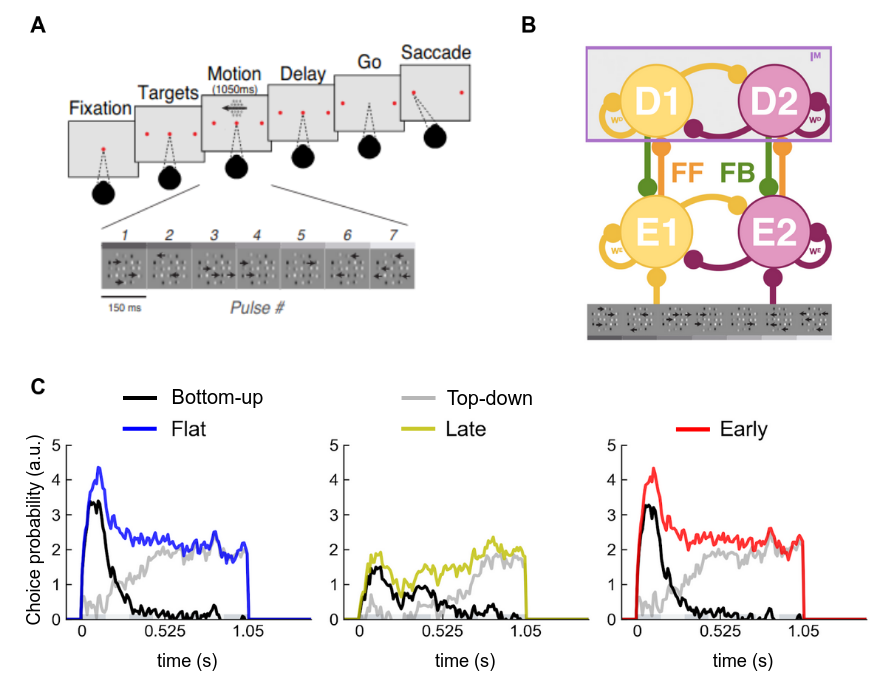
We found that macaque monkeys learn different temporal weighting strategies through exposure to a motion discrimination task with stimulus statistics (Figure 1A). Their pre-stimulus vigilance co-varied with the temporal weighting profile, highlighting the role of internal state in evidence accumulation. Moreover, analyses of middle temporal (MT) cortex reveal that while average population firing rates remain stable across weighting strategies, stimulus-related and choice-related activity depends on stimulus statistics in non-trivial ways.
To explain these findings, we introduce a two-area firing rate model comprising interconnected sensory and decision circuits (Figure 1B). A modulatory signal regulates the attractor dynamics of the decision circuit, initiating evidence integration and shaping decision timing. By varying manipulating this signal, the model reproduces early, flat, and late temporal weighting. Bidirectional connectivity dissociates choice probability (CP) into early stimulus-driven and late decision-related components, reproducing distinct CP time courses across conditions (Figure 1C).
Finally, task-optimized recurrent neural networks (RNN) show that introducing contextual signals enables flexible temporal weighting, faster learning, and generalization, identifying contextual modulation as a unifying mechanism for adaptive temporal integration.
Visual operators (e.g. edge detectors) are classically modelled using small circuits involving canonical computations, such as template-matching and gain control. Circuit models explain many aspects of the empirical descriptors that are used to characterize local visual operators, from sensitivity to noise-based estimates of perceptual kernels. Notwithstanding their utility, these models fail to provide a unified framework encompassing the variety of effects observed experimentally, such as the impact of contrast, SNR, and attention on the above descriptors. My goal is to start with a simple, plausible geometrical representation of the perceptual operation carried out by the observer, and to show that this representation is sufficiently expressive to capture a wide range of empirical effects associated with elementary visual computations. The resulting framework offers a new perspective on specific empirical descriptors, such as perceptual kernels and their second-order variants. For example, it relates these descriptors to notions of flatness and curvature in perceptual space. More generally, it suggests an intuitive geometrical model in which perception acts as a surveyor charting a sensory landscape of the external world: intrinsic factors, like attention, control the ability of the surveyor to accurately measure the landscape, while extrinsic factors, like stimulus contrast, shape the geometry of the landscape itself.
Coordination across brain regions is usually summarised by pairwise functional connectivity (FC), which cannot capture how three or more regions act together beyond their pairwise couplings. Pairwise maximum-entropy (Ising) models reproduce many patterns but miss informative interactions. We ask which higher-order structure the data support, using Minimally Complex Models (MCMs): maximum-entropy models that partition regions into communities and keep all interaction orders within each. We turn them into a parameter-free read-out applied across brain states. Each MCM has a closed-form Bayesian evidence whose negative log is asymptotically a description length, so community detection maximises this evidence over partitions: no inferred graph, no preset number of communities. The same quantity yields a per-region description length, a single index of organisation (shorter meaning more compressible coordination). On synthetic networks with a known planted partition, it matches Louvain modularity for purely pairwise interactions and outperforms it for higher-order interactions. Applied to Human Connectome Project resting-state fMRI (~984 young adults; 116 regions), MCMs recover eight communities resembling the resting-state (Yeo) systems plus subcortical regions, differing most in association systems. The population partition is stable (15/116 regions change between sessions), and individual partitions are more reproducible within than across participants (NMI 0.77 vs. 0.68), identifying individuals more accurately than pairwise FC. Across ~720 adults aged 36–100, resting activity requires a longer per-region description with age, becoming less compressible, alongside smaller communities (Pearson r=0.42). In a macaque central-thalamic deep-brain-stimulation dataset, it lengthens under propofol anaesthesia and is partially reversed by thalamic stimulation — most in visual, somatomotor and dorsal-attention networks, least in limbic and subcortical systems. Together, MCMs give a tractable account of higher-order functional organisation and how it changes across the lifespan, with preliminary evidence that the same read-out tracks the loss and recovery of consciousness.
Transcranial magnetic stimulation (TMS) is a powerful tool to modulate human brain function in a non-invasive fashion, with great potential for basic research and therapeutic applications. However, its effects may vary with pre-stimulus functional states (pFSs). This state dependency injects variability in TMS results, reducing their reproducibility and calling for experimental control. One way to exert such control is to measure a pFS of interest with electroencephalography (EEG), then use it to trigger TMS in real time. Unfortunately, pFSs tend to vanish before they can be fully processed. The solution to this problem is to forecast the EEG signal and program TMS to target the forecasted states, thereby compensating for processing delays. To this end, we have applied one traditional statistical model (univariate linear autoregression) and one generative deep learning model (WaveNet) to 64-channels task-related EEG data from 17 healthy young adults, obtaining accurate forecasts of attentional states up to 200 ms into the future. This work extends the traditional statistical model to previously untested horizons and explores the forecasting capabilities of deep learning approaches, opening doors for the use of complex pFS metrics in real-time EEG-TMS settings.
The forecasting study complements previous work on using convolutional neural networks (CNNs) to identify TMS-evoked activity from post-stimulus EEG data. Here, CNNs were trained on ~100.000 EEG samples at varying noise levels, reaching accuracies up to 96% and demonstrating an impressive robustness to a number of EEG artefacts. This result shows that TMS-evoked activity can be identified in an entirely automated fashion, potentially solving the problem of biased evaluations by human researchers. Taken together, the two studies describe a new way of doing brain stimulation research, where computational methods and large datasets help researchers overcome methodological challenges that have long prevented the establishment of TMS-EEG as a gold-standard technique.
Sensory neurons collectively encode stimulus information through patterns of correlated activity. A key — yet theoretically unresolved — observation is that neurons with similar stimulus tuning consistently show the strongest noise correlations. Existing frameworks fail to explain this structure, leaving a fundamental gap in our understanding.
We address this gap by introducing a fully geometric framework that characterizes how noise correlations influence stimulus encoding. In low-noise regimes, our approach unifies and extends classical results, including the Sign Rule and the detrimental role of information-limiting correlations, by recasting them in terms of the intrinsic geometry of the signal manifold. In high-noise regimes, the picture becomes substantially richer: we identify the geometric conditions under which noise correlations either enhance or impair coding fidelity. Strikingly, strong noise correlations can be beneficial, even when locally aligned with the signal manifold; a result that challenges conventional wisdom.
These findings revise and deepen our understanding of population coding in low-dimensional stimulus spaces, while providing a principled foundation for extending the analysis to high-dimensional settings.
The Auditory Brainstem Response (ABR) is a far-field EEG signal recorded from scalp electrodes to assess the integrity of the auditory pathway. Elicited by brief acoustic stimuli, the ABR reflects the activation of successive auditory brainstem nuclei and constitutes one of the most widely used clinical tools for hearing assessment. Despite its extensive clinical use, the relationship between the characteristic ABR waveform and its underlying neural generators remains incompletely understood.
In this work, we present a multi-scale computational framework that reconstructs the complete transformation from acoustic stimulation to scalp potentials by coupling a physiologically realistic spiking neural network of the human auditory brainstem with a biophysically detailed forward model. Acoustic stimuli are first converted into auditory nerve activity through a realistic cochlear model and propagated through a large-scale point-neuron network reproducing binaural processing and the tonotopic organization of the auditory brainstem. The resulting spiking activity of each neuronal population is projected onto morphologically detailed multicompartment neuron models using the HybridLFPy framework.
HybridLFPy exploits the linearity of extracellular field generation by replaying presynaptic spike trains onto passive multicompartment reconstructions, allowing the computation of the transmembrane currents generated throughout the neuronal morphology. These distributed membrane currents constitute the physical sources of extracellular potentials and are used to estimate the current dipole moments of each brainstem nucleus. The resulting dipole contributions are subsequently combined and projected through an analytical multilayer spherical head model to reconstruct scalp EEG potentials directly comparable to clinically recorded ABR waveforms.
This hybrid approach combines the computational efficiency of large-scale point-neuron simulations with the biophysical accuracy of multicompartment current-source modeling, overcoming the limitations of either methodology alone. By integrating realistic auditory processing and extracellular forward modeling within a unified simulation pipeline, this work establishes a foundation for interpreting ABR waveforms and relating them to their underlying neural generators.
We present a biologically grounded spiking closed-loop controller for investigating adaptive motor control. The controller was designed to actuate a robotic arm through the interaction of multiple brain-inspired modules, including a premotor planning module for trajectory generation, a primary motor cortex module for motor-command production and feedback correction, state estimation, and cerebellar forward and inverse internal models. In this framework, motor control emerges from the coordinated interaction between planning, cortical transformation of movement goals into motor commands, sensory feedback, and cerebellar prediction.
The premotor module generates desired joint trajectories and provides the reference signal. The primary motor cortex module transforms these trajectories into motor commands. This module includes a recurrent spiking network trained through eligibility-propagation (e-prop) learning, a biologically plausible mechanism in which synaptic updates depend on local activity traces and error-related learning signals.
The cerebellar component is composed of two biophysically grounded spiking microcircuits implementing complementary internal models, with online learning. The forward model receives efference copies of motor commands and learns to predict their sensory consequences, supporting faster and more reliable state estimation under delayed feedback. The inverse model receives desired trajectory and current state estimates, and contributes to refining motor output. Both cerebellar networks rely on biologically inspired plasticity driven by error signals.
The controller was tested with a virtual single-joint robotic arm simulated in a physics-based environment and interfaced (throughout the NeuroRobotics Platform) with neural simulations implemented in NEST simulator. Results show that the baseline controller (without plastic cerebellar models) can generate stable movements using delayed sensory feedback, although state estimation remains temporally lagged. The addition of cerebellar prediction improves state estimation, while inverse-model adaptation supports motor refinement once reliable state information is available. Preliminary perturbation experiments further highlight the potential of the framework for studying robustness and adaptive learning under altered environment/plant dynamics.
How mouse primary visual cortex (V1) represents time-varying stimuli is typically studied either through pairwise correlations or through black-box decoders that generalise poorly across animals. We ask whether the temporal reconfiguration of higher-order co-activation patterns carries stimulus information that these approaches miss, and whether topological data analysis can summarise it compactly.
We apply zigzag persistent homology to frame-by-frame population activity from the Sensorium-2023 movie dataset. We interpolate single-neuron responses onto a spatial grid and track loop-like (H₁) co-activation structures as they are born and die over time through a compressed summary statistic.
Two findings stand out. First, this topological summary transfers across animals: with only a linear classifier it matches or beats a black box model (3D-CNN trained on the raw grid) in cross-mouse decoding, even though the CNN wins within-animal. We run ablations to confirm the different source of signal: shuffling frame order or Fourier phase destroys the zigzag signal but not the CNN, while spatial shuffling does the reverse, thus identifying zigzag as a temporal, animal-invariant code.
Second, we confirm that the cross-mouse signal adds decoding power beyond standard descriptors: when the same decoder is already given firing rates, pairwise correlations, and higher-order summaries (co-active triplet and quadruplet counts, graph-theoretic measures) computed from the same activity, turnover still contributes a unique, reliable increment that none of those descriptors accounts for. This information lives in the temporal coherence of multiway co-activation, not in per-frame or lower-order summaries.
arge-scale brain activity is increasingly described in terms of spatiotemporal modes that capture coordinated neural dynamics across space and time. Such modes can be derived from diverse approaches, including structure-based decompositions informed by cortical geometry or anatomical connectivity, as well as data-driven techniques such as PCA, complex PCA (CPCA), frequency-domain PCA (fdPCA), and Dynamic Mode Decomposition (DMD). Despite their widespread use, comparing modes obtained from different methods remains challenging because each framework emphasizes different mathematical properties.
Here, we propose a simple and method-agnostic framework that separates the origin of a mode from its characterization. We represent each mode as a complex-valued spatial pattern, allowing its amplitude and phase to be analyzed independently. From this representation, we define two complementary observables: one quantifying the spatial organization of the mode and another quantifying its temporal organization through phase relationships across brain regions. Together, these observables provide a common language for describing spatiotemporal brain modes and distinguishing standing-like, propagating, spatially smooth, and spatially disordered patterns, regardless of the method used to derive them.
We apply this framework to resting-state fMRI data from rodents, demonstrating that it enables a compact and interpretable description of the repertoire of brain modes while facilitating direct comparisons across decomposition methods. By focusing on fundamental spatiotemporal properties rather than the specific algorithm used to extract them, this approach offers a general framework for the systematic analysis and comparison of large-scale brain dynamics.
Perceptual sensitivity in the visual domain pertains to the ability to detect informative features in visual scenes. As per efficient coding framework, this is achieved by becoming tuned to the statistical regularities of its environment. These regularities can be described as local correlations in light distribution, known as multipoint correlations. Previous studies characterized natural scene statistics using synthetic textures that allows control over different multipoint correlation, called Maximum Entropy Textures (MET). Human observers display sensitivity ranking that closely matches the variability of these statistics in natural scenes, thus consistent with the efficient coding. Similar ranking signatures have subsequently been reported in rodents and chicks. Despite this evidence, the underlying neural computations remain poorly understood.
To address this, we constructed a null model of early visual processing to determine how much of the observed phenomenon can be explained before invoking specialized higher-order mechanisms. We model simple-cells with Gabor functions, complex-cells with energy models, using these tractable computations as a benchmark. Responses to the same MET stimuli are analysed with a linear decoder to quantify the information available. We compare simple cells, complex cells, and mixed populations to evaluate their respective contributions.
Preliminary results indicate that populations of V1-like populations already contain substantial information about higher-order image statistics and largely reproduce qualitative trends reported experimentally. Secondly, matching receptive field properties reported in rodents further pointed towards the necessary parameters. While 1-point and 2-point correlations are readily decoded, sensitivity to higher-order statistics depends strongly on receptive field sizes, population size, and the number of training instances. These findings establish a computational baseline for investigating where and how sensitivity to higher-order image statistics emerges in the visual hierarchy and provide a modular platform for other studies involving V1.
Brain aging is characterized by cognitive decline related to progressive synaptic degradation. In zebrafish, aging progression resembles human one, making these fish an intriguing model to explore the interplay among aging, behaviour, synaptic integrity and environmental stress. We combined zebrafish deep learning based behavioral analysis of the two phases of behavioral experiment (habituation followed by sociability test) with confocal microscopy based synaptic reconstruction, to correlate behavioral and synaptic changes at different ages, in particular those emerging in response to the social isolation stress paradigm. Through DeepLabCut and Keypoint-MoSeq tools and custom Python pipeline, we observed that social deprivation significantly increased anxiety related behaviors in juvenile and adult fish compared to their controls, while this effect was not present in aged ones. Furthermore, second order Markov based entropy analysis revealed that social isolation yielded a restricted state space with more predictable transitions leading to an age-dependent stereotyped behavior. Such behavioral modification was coupled with a significant increment in glutamatergic synapses, indicative for long term synaptic plasticity, in brain regions related to stress (the homologue of mammalian amygdala) as revealed by Golgi-Cox staining and immunostaining for excitatory synaptic markers. When investigating social behavior, we found that the juvenile isolated fish were less social in respect to their control, presenting conspecific avoidance and enhanced freezing behavior, an effect not detected in adult and aged individuals. Latent Confirmatory factor model revealed that juvenile fish sociability latent factor was inversely predicted by the anxiety latent factor modeled in the habituation phase ($\beta = -0.54$).
Our findings indicate that social isolation has an age-dependent effect on animals’ behavior and related neural substrates, with younger animals exhibiting greater behavioral adaptability and neural plasticity respect to aged ones, which, in opposition, result in less responsiveness to environmental perturbations.
Economic choice involves comparing the subjective values of goods, a process linked to the orbitofrontal cortex (OFC). Neurophysiological studies have identified OFC neurons encoding variables that capture both the inputs and outputs of this process, such as the offer values and the chosen goods. However, the precise nature of these representations and the circuit mechanisms that give rise to choice remain open questions. To investigate these mechanisms, we combined large-scale neuronal recordings, network inference analyses, and theoretical modeling of circuit dynamics. We used simultaneous recordings of 50–150 neurons while monkeys performed a binary juice choice task and inferred Ising (Hopfield) models using the Adaptive Cluster Expansion algorithm. As an initial step, we characterized each neuron's tuning by identifying the variable it most strongly encoded. We then simulated the inferred network models under different offer inputs, and analyzed their stationary points. Simulations revealed attractor-like avalanche dynamics: stimulating offer value cells associated with one particular good (A or B) induced avalanches that led to the co-activation of other cell groups. Co-activated cells predominantly encoded the corresponding choice outcome (A or B). Compared to random networks, inferred OFC networks showed stronger avalanches. Ablation analyses indicated that direct connections between offer-value and chosen-good cells were crucial for generating correct decision-related avalanches, while other connections played a secondary, reinforcing role. These results suggest that OFC functions as an attractor network transforming offer values into binary choices.
Identifying cell assemblies from multi-unit recordings is a fundamental challenge in systems neuroscience. Most existing methods focus on detecting co-excited neurons, but neural circuits also involve inhibitory interactions, where the activation of an assembly can systematically suppress the firing of some of its members. Here we present a cell assembly detection algorithm that identifies assemblies of both excited and inhibited neurons from continuous neural signals, identify assemblies across multiple timescales, and correctly separates assemblies with partially overlapping membership.
The algorithm band-pass filters each unit's signal at a logarithmically spaced set of timescales, then tests pairwise correlations via a Fisher Z-statistic with an effective sample size correction for temporal autocorrelation. Significant pairs are grown into higher-order assemblies through an agglomerative procedure requiring each candidate unit to be significantly correlated with all current assembly members, enabling separation of assemblies with shared neurons that would otherwise be merged into a single spurious detection.
We validate the algorithm on three synthetic datasets of increasing complexity, demonstrating reliable detection of synchronous and sequential assemblies across timescales from 1ms to 1s, correct excited/inhibithed classification, and successful separation of overlapping assemblies. We further apply the algorithm to in-vivo recordings from mouse olfactory tubercle and anterior piriform cortex, recovering a cross-regional assembly consistent with known inhibitory projection between the two areas.
Recurrent connectivity is widely thought to support cognitive functions that require activity to persist beyond the timescale of sensory input, including working memory and delayed-response behavior. Classical theoretical models of recurrent neural networks, from the Hopfield model to more biologically detailed variants, have shown how recurrent architectures can implement distributed memory and persistent neural activity. However, many theoretical treatments separate learning and retrieval phases, by assuming recurrent connectivity does not interfere with external inputs during learning. Here, we make a step beyond this unrealistic assumption, asking how recurrent connectivity shapes the learning of novel stimuli, and whether additional plasticity mechanisms are required for stable memory storage and recall when recurrent connections are not neglected during learning.
We investigate a rate-based recurrent network equipped with a biologically constrained Hebbian learning rule. The rule is motivated by in vivo measurements of how response distributions in inferotemporal cortex change as initially novel stimuli become familiar. As a first step, we analyze the learning and retrieval of two activity patterns using mean-field theory and network simulations. The network can store and retrieve the first pattern. However, when a second pattern is presented for learning, strong recurrent input biases the network state toward the previously stored representation. As a result, the synaptic update reinforces the first pattern together with the second, leading to representational collapse and a single attractor correlated with both patterns. Simulations confirm this mean-field prediction.
These results suggest that recurrent connections, while essential for memory retrieval, can interfere with the storage of new memories unless additional mechanisms decorrelate sensory responses from previously learned representations. We thus extend the mean-field theory to multiple scenarios, including cholinergic suppression of recurrent input during learning and a BCM-like mechanism, and investigate in which parameter regions stable learning occurs in these scenarios.
Rodent vision has traditionally been considered simple and dominated by low-level feature extraction. This view has been recently challenged by evidence of a hierarchical visual system in rats, functionally analogous to the primate ventral stream, in which higher-order areas show reduced sensitivity to low-level attributes (e.g., luminance) and increased invariance to geometric transformations (e.g., translations, rotations). However, these findings were derived almost entirely from simplified parametric stimuli, leaving open whether the same organization holds under naturalistic stimulation.
We addressed this gap by performing extracellular recordings along the rat “ventral stream” during fast stimulation with 992 natural images spanning 62 ImageNet categories. For each reliably responsive unit, we computed neural predictivity layer-by-layer using convolutional neural networks (CNNs) under distinct training regimes (untrained, supervised, L2-robustified), applying the same pipeline to public macaque and mouse datasets for cross-species comparison.
As expected, macaque hierarchy was recapitulated by network depth, while no such correspondence emerged in the mouse. The rat occupied an intermediate position: network predictivity across depth aligned with cortical hierarchy, but the progression was less sharply delineated than in the macaque, while remaining distinguishable from the flat mouse profile. Information imbalance analysis corroborated this conclusion, showing the signature of a functional processing hierarchy resembling the one of macaques and CNNs, more than mouse visual areas did. However, decoding category information revealed that this hierarchical organization coexists with a persistent encoding of luminance across the rat hierarchy, decreasing but not disappearing with depth.
Together, these results indicate that hierarchical visual processing in the rat extends to naturalistic images, yielding a graded, intermediate organization in which low-level statistics remain partially entangled with higher-order representations, unlike the degree of feature abstraction seen in primate inferotemporal cortex.
Humans and animals often engage in behaviors not driven by immediate extrinsic rewards, such as exploring novel objects. This tendency to be curious, conserved across species, is thought to depend on intrinsic motivation, described in psychology as a general-purpose mechanism supporting adaptation to changing environments. Meanwhile, the AI community has incorporated intrinsic motivation into policies for artificial agents, showing performance improvement in specific tasks. However, despite these parallel efforts, a unified framework explaining how intrinsic motivation and curiosity may emerge from an elementary drive towards survival (or as a generalization over useful extrinsic goals) is still lacking.
We hypothesize that curiosity arises through repeated interactions with dynamic environments featuring variable action-reward contingencies, both within and across generations. To test this, we trained artificial agents on a reward collection task in a grid world with two rooms connected by a corridor. The initial room contains an object and sparse rewards, while the second room is richer but initially inaccessible. Although the object itself provides no reward, visiting it unlocks access to the richer room. Crucially, object identity and position vary across trials, requiring agents to abstract the relevance of novelty beyond trial-specific features. We show that recurrent neural networks (RNNs) learn the task and develop a preference for the object, suggesting the emergence of an intrinsic preference for an unrewarding item.
Importantly, novelty is a relative property: an object is novel only with respect to previously encountered items. To make the emerging tendency more comparable to biological curiosity towards novel objects, we are currently testing RNNs in a task variant where the target object must be identified among non-instrumental distractors. Finally, we aim to translate this paradigm into a human experiment, enabling direct comparison with artificial agents within a unified framework for studying intrinsic motivation and curious behavior.
The brain constantly interprets the world by combining incoming sensory information with prior knowledge, updating its beliefs as circumstances evolve. This process is captured by Bayesian inference, and its proper functioning determines whether an organism adapts flexibly to uncertainty or falls into systematic biases through faulty beliefs or maladaptive updating. Our main focus is to disentangle how the accumulated past evidence combines with the present information in making decisions. Specifically, we analyze how the history rewards and sensory evidence jointly shape sequential decision-making. In our task, the rewarded choice follows a Markov process governed by a stickiness parameter p. Optimal performance requires implicitly estimating p and adopting the appropriate win-stay/lose-shift strategy. Sixteen human participants completed a combined experiment made of three tasks: a probability task where the choices are made relying solely on reward history, a sensory task based on tactile discrimination only, and a combined condition integrating both sources of evidence. We model participants as Bayesian observers using a leaky integrator that tracks environmental stickiness according to the expectedness of the past trial outcome, and embed sensory processing within a binary classification framework that accounts for each individual's perceptual sensitivity. We incorporate choice stochasticity via a choice precision mechanism, which is integrated with a confidence mechanism to quantify how participants revise their beliefs following unrewarded trials. Fitting the model via hierarchical Bayesian inference with Hamiltonian Monte Carlo, we show that a few interpretable parameters capture a broad range of behavioral patterns. The model reproduces key features of human behavior, most notably a tendency to reduce confidence in its belief after incorrect trials and increase updating after unexpected outcomes. This pattern reflects a trade-off between exploratory updating and perseveration. Parameter estimates further expose meaningful individual differences and biases across participants.
Brains routinely generate highly flexible and complex behaviors on a relatively stable structure and limited resources. A key mechanism underlying this ability is compositionality, which allows the brain to efficiently decompose complex tasks into simpler, reusable primitives. While network modularity has often been linked to compositionality in biological and artificial networks, a rigorous mathematical characterization of this relationship in nonlinear networks is still lacking.
We investigate how structural modularity enables functional compositionality in inhibition-dominated threshold-linear networks (TLNs). We introduce a novel class of modular network assembly called low-rank gluings, where component subnetworks with arbitrary internal connectivity are connected via specific low-rank couplings. Low-rank intercomponent connectivity has recently garnered interest in neuroscience as a model for low-dimensional communication subspaces between brain regions. For these networks, we show that their global fixed points are constrained to be combinations of the local fixed points of their constituent modules. For a more structured subclass, called rank-1 gluings, we provide a complete characterization that determines which combinations of local fixed points yield global ones.
By applying this framework to graph-based TLNs, we show that these gluing rules provide a mathematically tractable recipe to build architectures with combinatorially many attractors ranging from compositions of discrete fixed points to compositional limit cycles. This framework expands the modeler's toolbox and suggests candidate architectures by which biological networks might generate a range of complex behaviors from a limited set of building blocks.
To investigate both the storage of phase-coded oscillatory patterns, and the scale-free behaviour near the transition between the replay and not-replay regimes, we study a modular spiking neural network composed of leaky integrate-and-fire neurons and governed by spike-timing-dependent plasticity. Our model stores modular spatiotemporal patterns both at the mesoscopic level (sequences of modules) and at the microscopic level (precise spike timings) We investigate how the temporal structure influences the network's capacity to encode and selectively retrieve multiple dynamical patterns while considering biological constraints such as the cost of long-range connectivity. The scale-free avalanches near the edge of instability are studied. Our results offer insight into how spatiotemporal coding and network organization support robust, large-scale memory storage and replay, and characterize the regime close to the transition. Empirical MEG data are compared with prediction of the model informed with tractography.
How do we understand each other? Inferring communicative intentions – such as clarification requests, invitations, orders, statements – is fundamental to social interaction. Without this ability, a question like "Can you pass me the salt?" would be met with a literal "Yes, I can" rather than the intended action.
Crucially, in face-to-face interaction, inferring intentions relies not only on linguistic meaning, but is also fundamentally shaped by prosodic intonation and visual cues such as facial expressions and head movements. How prosodic and facial cues contribute to this process, however, remains largely unexplored. Here, we aim to systematically assess how the two jointly shape intention recognition.
In a categorization task, participants will judge the intention (clarification, statement, invitation, order, other) expressed by an actor who utters a single word in audiovisual recordings. Normed single words were chosen to reduce their semantic influence on intention recognition.
A perturbation paradigm recombines audio and video across intentions, varying how plausible each pairing is in natural communication.
We predict that intention arises from the flexible arbitration between cue integration and segregation, formalized by Bayesian causal inference: cues attributed to a common source fuse into non-additive percepts (a combined reading different from the sum of the single cues), while cues judged independent yield reliance on the most diagnostic one.
Further, fMRI and EEG experiments will examine how this process is implemented across the cortical hierarchy. Representational Similarity Analysis (RSA) will test where (fMRI) and when (EEG) neural representational dissimilarity matrices (RDMs) align with model-derived RDMs at multiple processing levels, from low-level sensory features to higher-level representations (confusion matrices from behavioral performance and computational modelling).
Collectively, the project will unveil the computational principles and neural implementation driving how the brain recovers communicative intentions from face-to-face interaction.
Understanding how the visual system extracts and represents information is a fundamental prerequisite for studying cognitive processes that depend on vision, such as time perception. Yet, defining and controlling the amount of information in, for instance, natural images is a daunting task, owing to their rich, high-dimensional statistical structure, which is further complicated by their semantic content. To overcome this problem, Victor & Conte (2012) have introduced binary maximum-entropy textures, a class of artificial images with tunable local multipoint correlation patterns. While these textures have found experimental applications (e.g., Hermundstad et al., 2014), a rigorous measure for their information content is lacking, limiting their use and theoretical value. We address this issue using the theory of higher-order spin models. Following Beretta et al. (2018), we compute the intrinsic statistical information of the textures as the geometric complexity of the underlying spin model. The main result is that all textures defined by a single correlation pattern are equivalent in terms of their intrinsic complexity. In contrast, visual sensitivity differs per pattern type (Hermundstad et al., 2014), indicating that the visual system has adopted an internal model that goes beyond the intrinsic structure of these images. We are developing measures of complexity that account for this. In addition, we are generalising our results to textures that mix patterns, along with efficient algorithms for generating them. As an application of this, we conduct time perception experiments, showing that the more extractable information a texture contains, the longer its perceived duration is. Taken together, we extend both the theoretical understanding and experimental use of the textures for investigating how stimulus complexity affects vision-dependent processes.
Computational, theoretical, and systems neuroscience increasingly rely on abstract models, simulations, and large-scale datasets. This creates a responsibility to properly train students and early-stage researchers, the next generation of neuroscientists, who will encounter such data in their scientific practice. Before analysing complex neural datasets, learners should have the opportunity to develop an intuitive understanding of how neural signals are generated, recorded, transformed, and shaped by experimental conditions. Without this foundation, there is a risk that large-scale datasets become detached from the biological and methodological realities that produced them.
Here, we present Spikeling, an open-source hardware and software platform built around artificial spiking neurons, designed to make core concepts in computational, theoretical, and systems neuroscience experimentally accessible. Through a hands-on interface, users can manipulate parameters related to excitability, stimulation, synaptic input, noise, threshold, and firing dynamics, while observing neural-like activity in real time. This allows learners to connect model assumptions and parameter regimes to observable electrophysiological signals.
Spikeling supports the exploration of experimental recording workflows, from electrophysiology-inspired voltage traces to calcium-imaging-like representations and downstream analysis. In this way, the platform helps learners understand not only what neural datasets represent, but also how they are collected, processed, and constrained by the experimental methods used. As a result, this provides a practical intermediate step before working with larger and more complex neural datasets.
Because the hardware and software are open-source, Spikeling is intended to support reproducible education, transparent methods, and community-driven modification. It also contributes to 3Rs-compatible teaching by reducing the need for live animal demonstrations in introductory contexts, while preparing students more effectively for biological experiments.
We propose Spikeling as a practical bridge between equations, simulations, recordings, and analysis: a tool for making theoretical and computational neuroscience tangible before moving to complex experimental systems.
In computational vision science, Convolutional Neural Networks (CNNs) have
emerged as a popular model of biological vision because of the alignment they
can exhibit with neural and behavioral data in humans and animals. However, it
is unclear to what extent this alignment persists for visual tasks that stray from
the canonical object recognition with well-defined semantic content. In this study,
we diverge from the common object-centric view by focusing on another aspect of
vision: texture perception. We consider textures of different complexity generated
with three different algorithms from the same source images. Using a rank-based
statistic, we quantify the information encoded in the internal representations of
a CNN and three Vision Transformers (ViTs), and we compare the similarity of
these representations to those inferred from human psychophysics data. We find
that the representation of textures is aligned in different ViTs, but not between
the ViTs and the CNN; that ViTs form similar representations for textures of dif-
ferent complexity; that human performance in recognizing textures can be better
predicted from ViTs representations rather than CNN representations. Taken to-
gether, these results suggest that ViTs may capture more faithfully than CNNs
how texture patterns are visually processed by humans, and that the representa-
tional geometry of texture stimuli in computational models may be driven by the
network architecture.
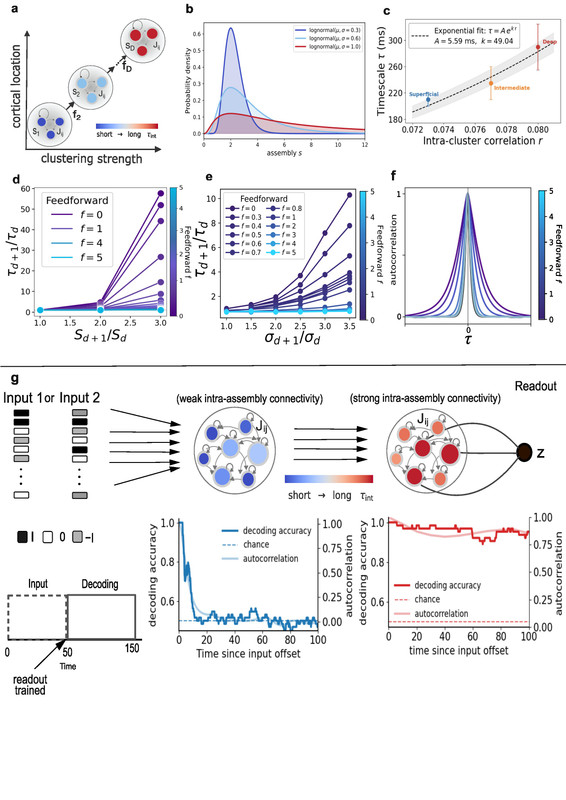
Cortical activity displays a hierarchy of timescales along the anatomical hierarchy, thought to support information integration over multiple timescales. Clustered network architecture has been shown to generate heterogeneous timescales and support temporal fluctuations when the clustering of neurons is substantial.
Working memory relies on long timescales and a persistent neural signal. Classical attractor models tie this persistence to fixed firing rates, in discrepancy with dynamic cortical activity, while trajectory-based alternatives lack clear readouts and require training.
This work proposes a unified circuit-level model in which the timescale hierarchy and long-lasting working memory emerge from the metastable dynamics of clustered recurrent networks. Dynamical mean-field theory is developed for a feedforward chain of homogeneously clustered layers. A graded increase of intra-cluster coupling along the chain is necessary to reproduce the cortical gradient of timescales, consistent with the empirical co-gradient of recurrent connections, spine density, and integration windows along the occipito-frontal axis. These predictions match volumetric calcium imaging of cortical activity, where deeper layers exhibit stronger clustering and longer intrinsic timescales.
However, within-area timescales follow a log-normal distribution; reproducing this requires layers whose assembly sizes are log-normally distributed. A log-normal distribution that broadens along the chain reproduces the empirical across-area gradient of mean timescales and is consistent with larger within-area timescale variability in higher-order areas.
The same architecture supports working memory without training: transient inputs to fast units are integrated into the slow baseline activity of strongly clustered assemblies, remaining decodable long after stimulus offset; memory propagates and persists in deep layers.
Since clustered assemblies are common in cortical organization, these results suggest that heterogeneous clustering across areas underlies the cortical timescale hierarchy and that working memory is an inherent property of cortical circuits, reconciling persistence, dynamic activity, and efficient readout in a biologically plausible architecture.
Characterizing directed connections between brain regions is fundamental for understanding the brain’s network organization and how it supports cognitive processes. However, a reliable methodology allowing assessment of effective connectivity (EC) at the whole-brain level and across high-resolution parcellations has remained elusive. Here, using fMRI data from the Human Connectome Project S1200 release, we show that the multivariate Ornstein-Uhlenbeck (mOU) approach for EC estimation can be adapted to yield EC estimates that are in broad agreement with those of an advanced dynamic causal model (DCM), at least for healthy participants for which inter-regional differences in hemodynamic responses remain small. In particular, we analytically decompose the Jacobian into symmetric and antisymmetric components, showing that the time scale τ explicitly controls their relative contribution and thus regulates the emergence of directionality in EC estimates. We explore a wide range of τ values, and identify regimes in which the optimization converges and yields stable EC matrices, remarkably consistent with DCM. Furthermore, thanks to its low computational cost, mOU can be easily scaled up to large neuroimaging cohorts and high-resolution parcellations. We show that MOU-based EC is reliable for high-resolution parcellations and outperforms functional connectivity (FC) in single-subject connectome fingerprinting, with accuracy increasing with resolution level, pinpointing the method’s potential in identifying subject-specific functional features. Finally, mOU-based whole-brain EC can be used to uncover directed community structure and functional hierarchies in large-scale brain organization, features that are inaccessible using undirected measures, such as FC. Overall, our methodology provides a reliable and scalable EC estimation pipeline of wide applicability to cognitive and network neuroscience
Behavior is visible, but the internal processes that generate it are not. Inferring these hidden computations and states is a central challenge in systems and computational neuroscience. The same action can arise from different strategies, while other ongoing processes may not be expressed in the current choice. We addressed this challenge in a mouse foraging task with multiple computational solutions. By combining behavioral modeling, large-scale neural recordings, optogenetic perturbations, and facial videography, we tracked latent variables across behavior, neural activity, and movement. We found that mice used distinct computations over reward and failure history to decide when to leave a foraging site. Yet population activity in the secondary motor cortex (M2) simultaneously represented variables supporting both current and unused alternative strategies. The same variables could be decoded from subtle and reproducible facial movements, and partial M2 inactivation reduced the accuracy and delayed the emergence of this facial readout. Together, these findings show that otherwise hidden internal processes can be exposed by linking formal models to high-dimensional neural and behavioral signals. More broadly, they expand what can count as a readout of internal processes: what is hidden from choice may leave structured traces in neural activity and movement that we are only beginning to read.
How does the brain transform sensory input into perceptual decisions? In this talk, I will present work from my lab addressing this question at multiple levels of the cortical hierarchy, combining large-scale population recordings, optogenetic manipulations, and behavioral tasks. I will begin with the primary visual cortex: our data reveal encoding that extends well beyond classical visual tuning — yet the functional significance of this non-visual information remains unclear. Moving upstream, higher-order areas exhibit rich, multiplexed representations of sensory, motor, and decision-related variables, but the link between these neuronal representations and behavioural output remains unresolved. I will then present preliminary results challenging canonical accounts of sensory tuning and sensorimotor transformation in the visual system, pointing toward a more dynamic and context-dependent picture than standard hierarchical models predict. Together, these findings paint a picture of the distributed cortical network for visual processing and decision making that raises as many questions as it answers — and reveals how little we still know about the neural mechanisms of perception.
Information processing within sensory circuits relies on adaptive mechanisms to cope with changes in the environment. Environmental conditions do not only determine the statistics of sensory stimuli but also affect how neural circuits operate and develop. In my lab we investigate how key adaptive computations are implemented in the fly olfactory system and how they are maintained across environmental conditions that affect the wiring of the olfactory circuit.
In Drosophila melanogaster, we have shown that brain connectivity scales inversely with developmental temperature: lower temperatures lead to the formation of more synapses and the recruitment of additional synaptic partners. This temperature-dependent connectomes likely harness similar functions but also potentially support adaptive behaviors. I will discuss our current understanding of the origin of temperature dependent wiring in the fly brain and the implications for odor coding robustness and odor-drive behavior.
Understanding how brain network structure gives rise to function requires measuring connectivity and activity in the same circuit. While inferring connections from spike trains has long been proposed as a solution, correlated inputs cause existing methods to detect many spurious connections. Using spiking network models, we systematically identified features of the spike-time cross-correlogram that distinguish true monosynaptic interactions from correlations due to common inputs, and trained a convolutional network to recognize such features (Dyad).
We validated Dyad using two simulated datasets (one EI balanced network, one ring model) and two published electrophysiological datasets with experimentally identified monosynaptic connectivity (one excitatory, one inhibitory). In all benchmarks, Dyad recovered more than half of the connections at a precision above 95%, substantially outperforming all previous approaches.
We then applied Dyad to two in vivo electrophysiological datasets — recorded in mouse visual cortex and post-subiculum. In both datasets, neurons with putative excitatory outputs had few putative inhibitory outputs, and vice versa, indicating a low rate of spurious connections.
In the visual cortex, when relating synaptic connectivity inferred from spontaneous activity to the pairwise similarity of Gabor responses, we found a like-to-like organization that extends beyond excitatory V1 neurons to span both cell classes across the visual cortex, and that cannot be explained by spatial proximity alone. We additionally identified a subpopulation of off-center, on-surround excitatory neurons that preferentially connect — both to and from — inhibitory neurons with overlapping but oppositely modulated receptive fields.
In the post-subiculum, part of the multi-stage head-direction system, we found sparse recurrent excitation (confirming in-slice work) together with unspecific inhibition, indicating that its head-direction attractor dynamics are inherited from upstream rather than locally generated.
Together, these results establish Dyad as a scalable, validated framework for inferring monosynaptic connectivity from large-scale recordings, opening a tractable route for dissecting circuit organization.
Atypical sensory integration and contextual learning are common symptoms in autism spectrum disorder (ASD), but how sensory circuits are affected remains elusive. Here we focused on the early visual information processing, and performed in vivo two-photon calcium imaging and pupillometry of mice engaged in an implicit learning task in stable and volatile visual contexts. Wild-type (WT) mice show stimulus-specific contextual modulation of the visual responses in the superior colliculus (SC) and pupil dynamics, whereas SCN2A-haploinsufficient ASD-model mice exhibit abnormal modulation patterns. In both genotypes, feedforward inputs from the retina to SC demonstrate no such contextual modulation. In contrast, feedback inputs from the primary visual cortex (V1) show modulation patterns similar to those of SC cells in WT mice, but no modulation in Scn2a+/- mice. Furthermore, chemogenetic perturbation reveals that this top-down signaling from V1 to SC mediates the observed contextual modulation both at the neurophysiological and behavioral levels. These results suggest that the corticotectal input is critical for contextual sensory integration in SC, and its anomaly underlies atypical sensory learning in ASD.
Efficient coding theory proposes that perceptual systems maximize information while minimizing redundancy by tuning neural representations to natural signal statistics (Simoncelli & Olshausen, 2001). In vision, these statistics take the form of local spatial correlations in the light distribution, known as multipoint correlations. Multipoint correlations that vary most across natural scenes should be more informative and perceptually salient. For configurations of up to four pixels, natural-image variability is highest for 2-point correlations, followed by 4-point and 3-point correlations. Human sensitivity follows the same ranking (Hermundstad et al., 2014), as shown using Maximum Entropy Textures (METs), synthetic binary textures that allow precise manipulation of individual correlations (Victor & Conte, 2012). However, the neural mechanisms underlying this efficient sensitivity remain unclear. The rat visual system offers a useful model for investigating these mechanisms, particularly because rats exhibit a perceptual sensitivity ranking for multipoint correlations similar to that reported in humans (Caramellino et al., 2021). We used METs to examine how these statistics are represented along the rat homolog of the primate ventral visual stream. Multi-unit extracellular activity was recorded with Neuropixels probes in early areas V1 and LM and higher-level areas LI and LL. Using a population decoding analysis, we found that the behavioral sensitivity ranking previously reported in rats is not reflected in neural responses upstream of area LI. Higher-level areas also showed greater visual invariance, consistent with progressive abstraction of stimulus representations along the hierarchy. Additionally, higher-order correlations elicited firing-rate suppression relative to noise in early areas, suggesting limited or indirect encoding. They also produced more heterogeneous response patterns across units than lower-order correlations, indicating a diverse population code. These findings provide a neural account of efficient sensitivity to multipoint correlations, suggesting that it develops progressively along the visual hierarchy through contextual modulation and higher-level representational transformations.
Local field potentials (LFPs), the low-frequency component of the extracellular potential, are widely interpreted as readouts of population synaptic activity¹, an assumption derived almost entirely from cortical recordings. Whether these principles extend to subcortical structures remains unclear. Here, we address this question in the subthalamic nucleus (STN), where LFPs are routinely recorded and used to guide adaptive deep brain stimulation for Parkinson's disease². We built a biophysically detailed population model of the STN and validated it against patient microelectrode recordings³. As in the cortex, we found that STN extracellular potentials were dominated by synaptic currents. Unlike in the cortex⁴, however, LFPs could not be reliably predicted from these currents or from other average population measures. We showed that this discrepancy arises from the STN's symmetric neuronal morphology and lack of recurrent connectivity, which promote destructive interference among single-neuron contributions, thereby decoupling the LFP from population-level dynamics. However, this decoupling was not absolute: when we introduced pathological beta synchrony and constrained the model using experimental data, a robust synapse–LFP relationship was restored through more consistent underlying dynamics. Furthermore, even in asynchronous settings, we found that the aperiodic slope of the power spectral density tracked STN neuronal morphology, firing rate, and excitatory–inhibitory balance.
Together, these findings challenge the prevailing view of LFPs as universal readouts of population activity. Our results show that the interpretability of extracellular signals depends critically on neuronal morphology and synchronization state, and provide a mechanistic framework for the use of STN LFPs as biomarkers in adaptive deep brain stimulation for Parkinson's disease.
In the hippocampus, reactivation of spatial memories during sleep enhances consolidation and recall. However, network dynamics may independently influence memory retention. We applied the Phenomenological Renormalization Group to CA1 neuronal activity in rats during sleep/rest epochs surrounding a spatial learning task. The scaling exponent of activity variance (α), assessed either before or after learning, predicted subsequent recall performance independently of reactivation. The prediction model was transferable across subjects, suggesting that it is a robust biomarker of learning ability. Single-cell features, such as burst propensity and intrinsic timescales, correlated with α and memory, α predicted retention even when controlling for these factors. Our results identified a link between scale-free circuit dynamics and memory stabilization, suggesting that the tuning of the underlying dynamical regime near criticality is a key determinant of memory longevity. Targeted modulation of these collective states could offer new avenues for memory enhancement.
A fundamental question in neuroscience is how a neuron’s specialized responses arise from the synaptic inputs distributed across its dendritic tree. Individual dendrites may function as independent computational subunits, receiving specialized inputs, driving somatic output through active mechanisms, and triggering bursts or plasticity when synaptic input coincides with back-propagating action potentials. These computational properties of cortical neurons have inspired models of sensory and motor processing, learning, and attention. However, directly testing these ideas in vivo has been challenging because available methods for causal dendritic manipulation have lacked sufficient sensitivity and spatial resolution.
In this talk, I will present recent work using novel optical and electrical probes to investigate the role of apical dendrites in sensory processing in visual cortical neurons. Specifically, we tested the hypothesis that apical dendrites convey information about the context surrounding a neuron’s receptive field.
First, I will show how two-photon imaging with the new glutamate sensor iGluSnFR4 enables measurement of the synaptic inputs driving apical dendrites in vivo (Aggarwal et al 2025). Combining this approach with dendritic pruning, we show causally that apical dendrites of visual cortical neurons integrate excitatory inputs from distant regions of visual space and amplify responses to large stimuli, revealing a causal dendritic contribution to the processing of sensory context (Liu et al, 2026).
Second, I will show how high-density Neuropixels probes enable the recording of extracellular signatures of back-propagating action potentials and dendritic spikes from cortical dendrites with high signal-to-noise ratio and temporal resolution (Ye et al, 2025). These unpublished data reveal that visual stimuli differentially engage two modes of somato-dendritic communication, with contextual stimuli strongly recruiting both back-propagation and forward-propagating dendritic electrogenesis.