Speaker
Description
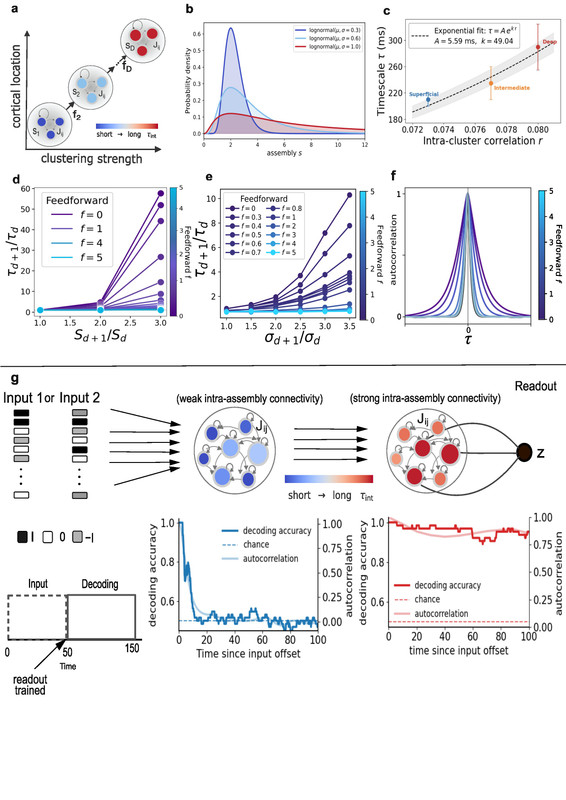
Cortical activity displays a hierarchy of timescales along the anatomical hierarchy, thought to support information integration over multiple timescales. Clustered network architecture has been shown to generate heterogeneous timescales and support temporal fluctuations when the clustering of neurons is substantial.
Working memory relies on long timescales and a persistent neural signal. Classical attractor models tie this persistence to fixed firing rates, in discrepancy with dynamic cortical activity, while trajectory-based alternatives lack clear readouts and require training.
This work proposes a unified circuit-level model in which the timescale hierarchy and long-lasting working memory emerge from the metastable dynamics of clustered recurrent networks. Dynamical mean-field theory is developed for a feedforward chain of homogeneously clustered layers. A graded increase of intra-cluster coupling along the chain is necessary to reproduce the cortical gradient of timescales, consistent with the empirical co-gradient of recurrent connections, spine density, and integration windows along the occipito-frontal axis. These predictions match volumetric calcium imaging of cortical activity, where deeper layers exhibit stronger clustering and longer intrinsic timescales.
However, within-area timescales follow a log-normal distribution; reproducing this requires layers whose assembly sizes are log-normally distributed. A log-normal distribution that broadens along the chain reproduces the empirical across-area gradient of mean timescales and is consistent with larger within-area timescale variability in higher-order areas.
The same architecture supports working memory without training: transient inputs to fast units are integrated into the slow baseline activity of strongly clustered assemblies, remaining decodable long after stimulus offset; memory propagates and persists in deep layers.
Since clustered assemblies are common in cortical organization, these results suggest that heterogeneous clustering across areas underlies the cortical timescale hierarchy and that working memory is an inherent property of cortical circuits, reconciling persistence, dynamic activity, and efficient readout in a biologically plausible architecture.
| Preferred Presentation | Oral Presentation |
|---|