Speaker
Description
Perceptual decision-making relies on the accumulation of sensory evidence over time to form discriminations. Classical models link this process to distinct psychophysical effects, including primacy-related early weighting, uniform integration, and recency-related weighting arising from leaky integration. However, experiments show that humans and non-human primates can flexibly adapt temporal weighting strategies to stimulus statistics, a capacity that current models of cortical dynamics do not fully explain.
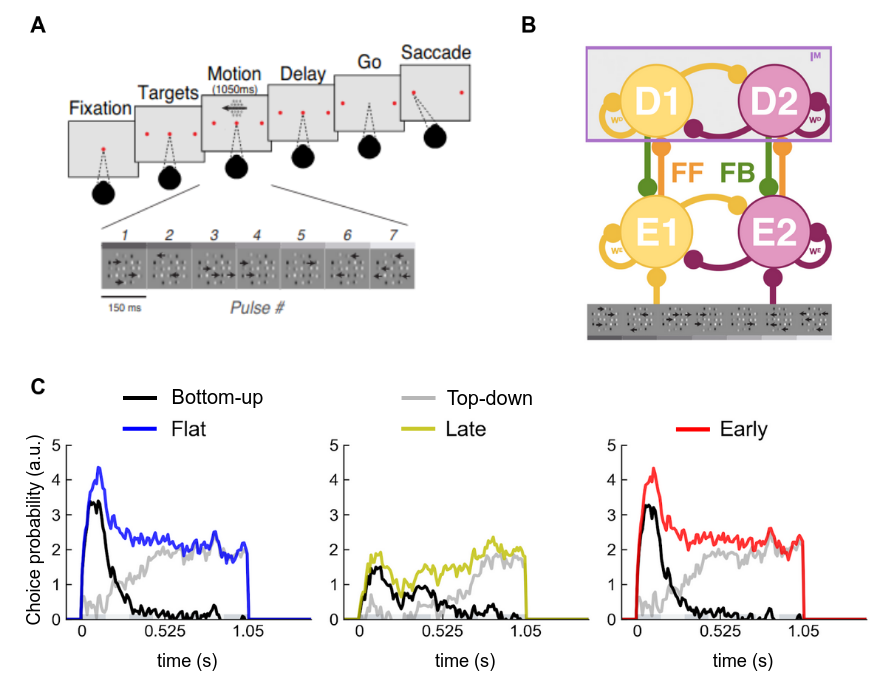
We found that macaque monkeys learn different temporal weighting strategies through exposure to a motion discrimination task with stimulus statistics (Figure 1A). Their pre-stimulus vigilance co-varied with the temporal weighting profile, highlighting the role of internal state in evidence accumulation. Moreover, analyses of middle temporal (MT) cortex reveal that while average population firing rates remain stable across weighting strategies, stimulus-related and choice-related activity depends on stimulus statistics in non-trivial ways.
To explain these findings, we introduce a two-area firing rate model comprising interconnected sensory and decision circuits (Figure 1B). A modulatory signal regulates the attractor dynamics of the decision circuit, initiating evidence integration and shaping decision timing. By varying manipulating this signal, the model reproduces early, flat, and late temporal weighting. Bidirectional connectivity dissociates choice probability (CP) into early stimulus-driven and late decision-related components, reproducing distinct CP time courses across conditions (Figure 1C).
Finally, task-optimized recurrent neural networks (RNN) show that introducing contextual signals enables flexible temporal weighting, faster learning, and generalization, identifying contextual modulation as a unifying mechanism for adaptive temporal integration.
| Preferred Presentation | Oral Presentation |
|---|